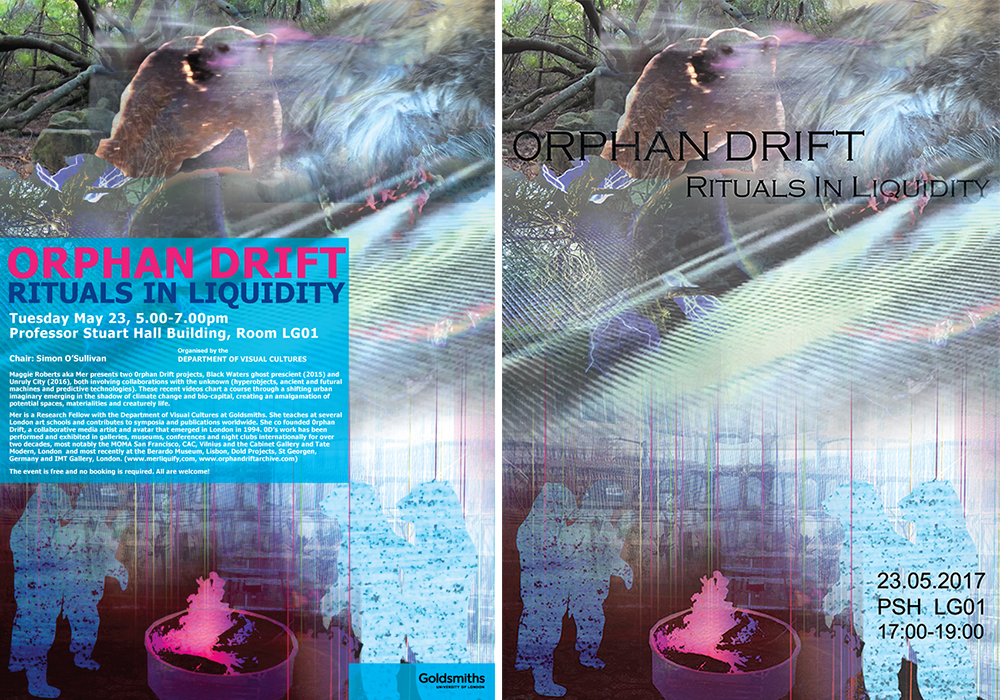
Mer/Maggie Roberts/ 0rphan Drift: “Rituals in Liquidity” (1:41:52) Department of Visual Cultures, Goldsmiths
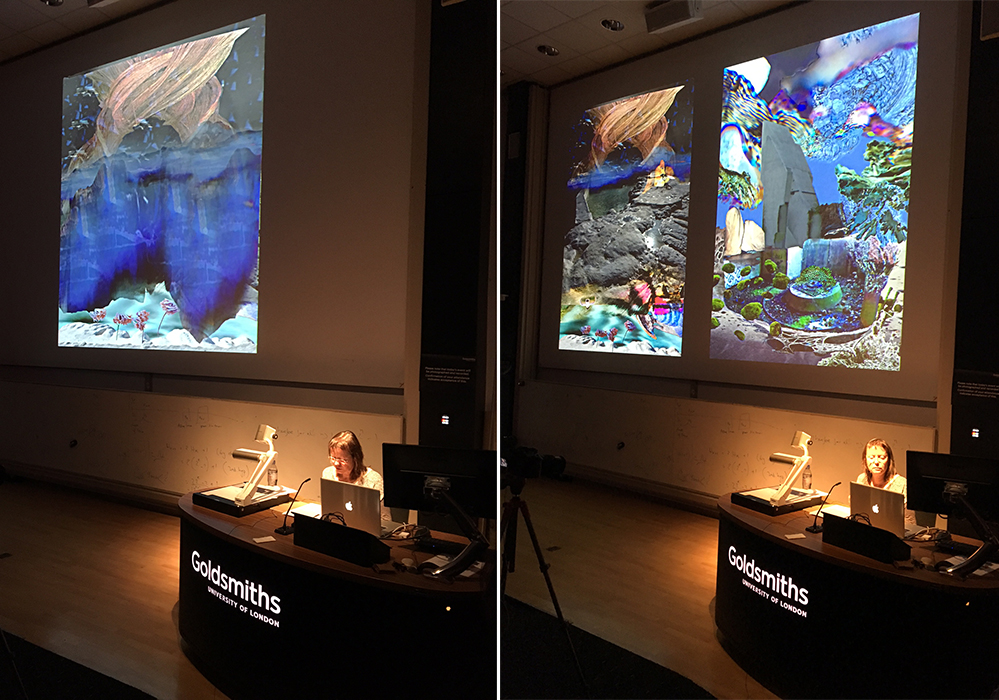
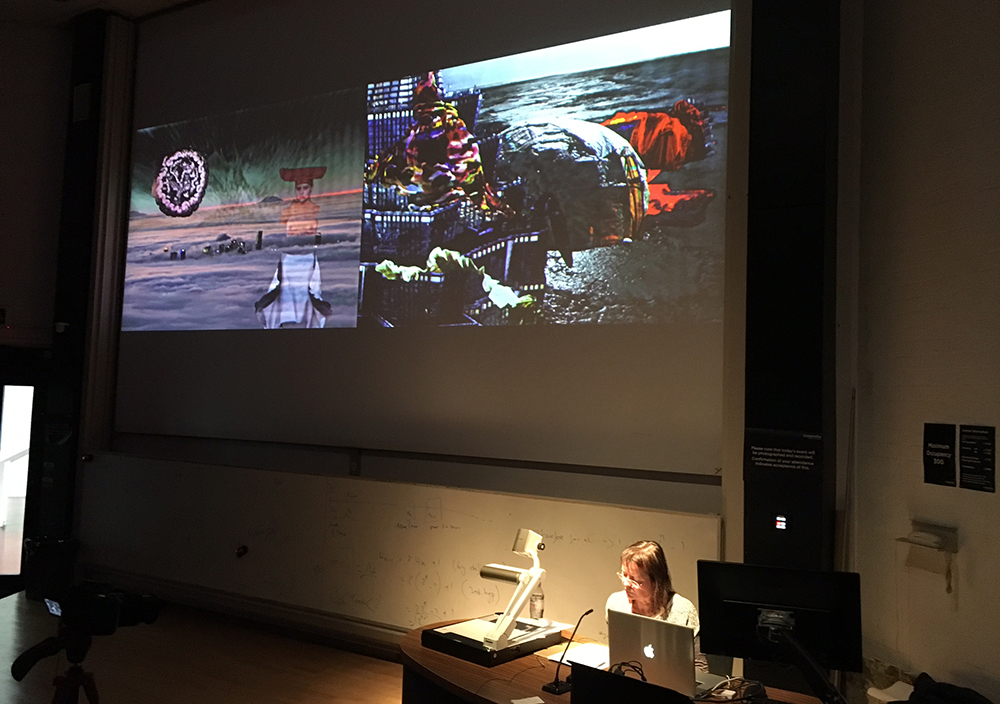
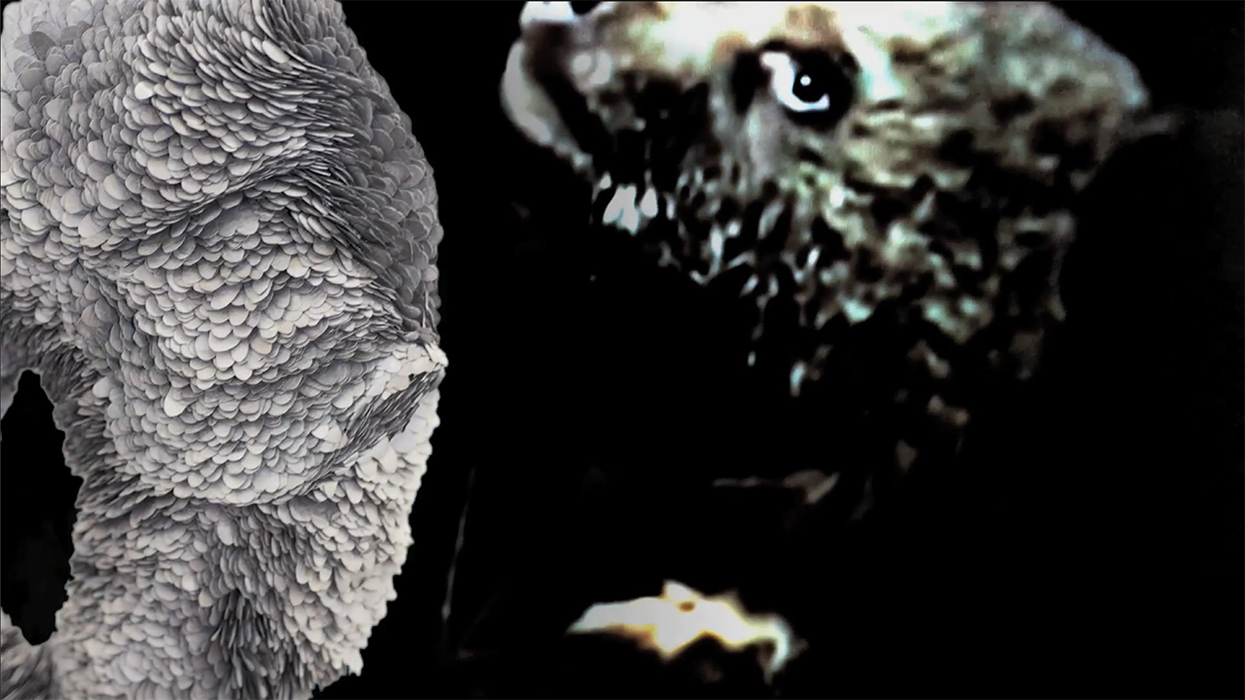
For the second talk during her Research Fellowship, Maggie Roberts aka Mer presented two 0rphan Drift projects, Black Waters ghost prescient (2015) and Unruly City (2016), discussing them both as collaborations with the unknown (hyperobjects, ancient and futural machines and predictive technologies). These videos chart a course through a shifting urban imaginary emerging in the shadow of climate change and bio-capital, creating an amalgamation of potential spaces, materialities and creaturely life.
We are reestablishing ritual as a methodology for the intensification of the work, which has to engage with focused urgency in the world. Harnessed to affective power, the image becomes a channeling device, an uncanny operator exposing the energy circuits that catalyse change. Employing tactics of metonymic slippage, mimetic contagion, mesmerism and awkward collaged animation, 0D’s liquefaction aesthetic describes magnetic oceans, permeable thresholds between the concrete and the virtual; continuous states of radical uncertainty; invisible currents and currencies affecting the visible: cosmic and geological time scales; ‘Machine Vision’; shamanic animal becomings; communication currents in vibrant matter that become effective frequencies in our habitats and fantasies; futurity impacting on the present and its hyperobjects, and Climate Change as the violence of excess and luxury.
Rituals in Liquidity Poster
Share
Total
1
Shares
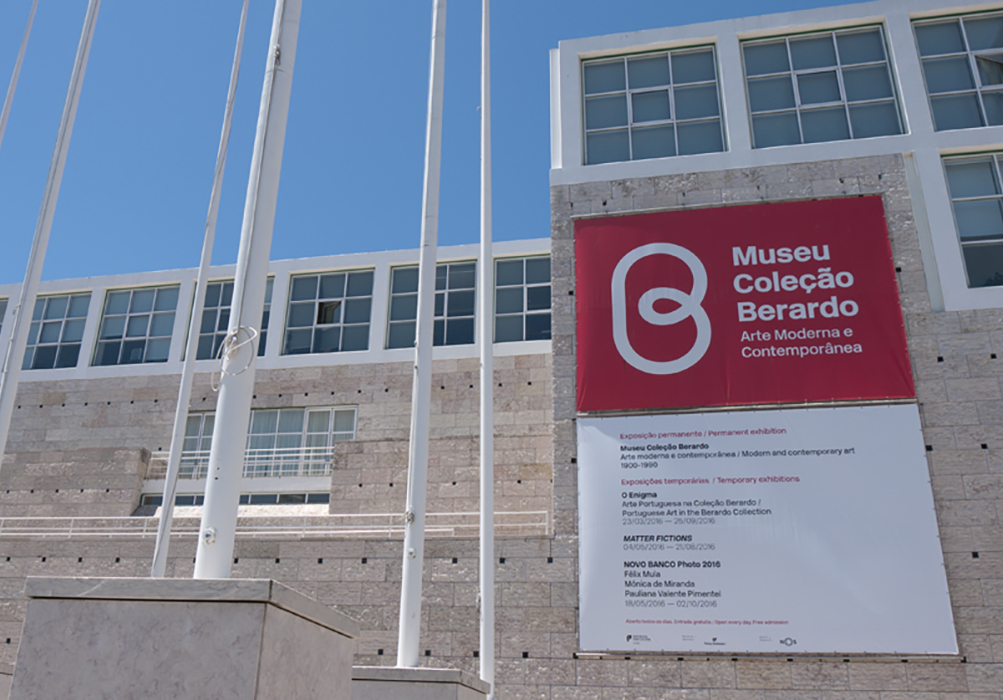
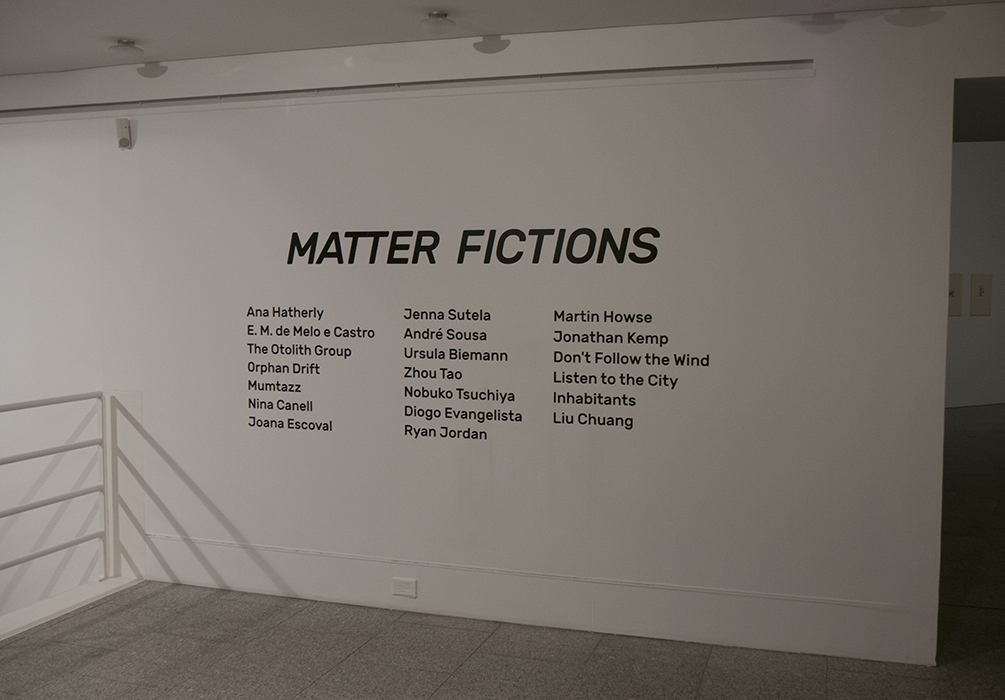
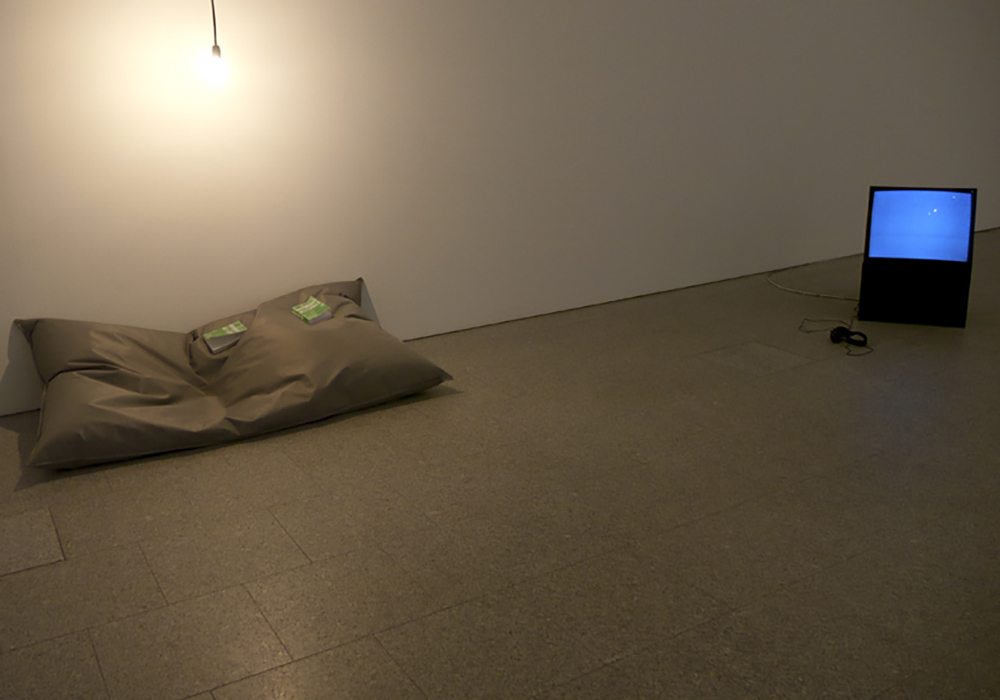
Matter Fictions at Museu Coleção Berardo, Lisbon :: 2016
CATALOGUE
Matter Fictions 2017 Edited by Margarida Mendes Published by Sternberg Press
Summary
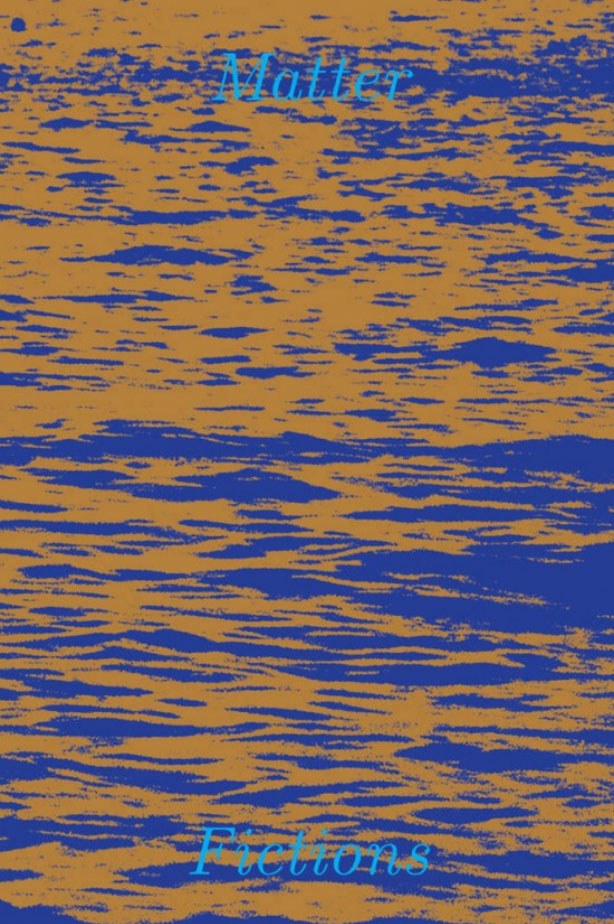
Matter Fictions Catalogue Cover
Matter Fictions addresses fiction as a mode of producing reality as well as the significance of matter—animal, vegetable, mineral, hybrid—beyond binaries. Recounting a partial history of our relation with matter, the eponymous exhibition at Museu Coleção Berardo (May 4–August 21, 2016) explored how the crossover between cosmological narratives, spatial revolutions of concrete poetry, and hypertextual and territorial fictions might impact our understanding of human agency in a time that calls for action on climate change and technocratic policies. This companion reader features contributions from participating artists and like-minded writers that address the scope of this project as it exceeds the frame of art and the exhibition into the realm of nonhuman ecologies, ontologies, and temporalities.
The texts are oriented around the four threads that structured the exhibition. The science-fiction approach to the ethics of code and digital space is addressed in the texts by Kodwo Eshun of the Otolith Group, Ccru (Cybernetic culture resource unit), and N. Katherine Hayles, and the excerpt from 0(rphan)d(rift>)’s 1995 novel Cyberpositive. Contemporary psychogeophysics and the material realities of the digital are explored by Jussi Parikka’s text and printed drawings throughout the book based on Joana Escoval’s sculptures on electromagnetic conduction. The hybridity of contemporary bodies and rituals is contextualized by Margarida Mendes’s essay on agribusiness and GMOs. And the critique of technocratic and extractionist environmental policies is represented by Jason Waite’s text on Fukushima and artist statements by Ursula Biemann and Mariana Silva. The contributions from Jennifer Teets and Francis McKee straddle all four threads—Teets’s through a reflection on the ongoing series at Museu Berardo, The World in Which We Occur, which she organizes with Mendes, and McKee’s through a newly commissioned work of fiction.
Co published with Museu Coleção Berardo
Contributors 0rphan Drift, Ursula Biemann, Ccru, Kodwo Eshun, N. Katherine Hayles, Francis McKee, Margarida Mendes, Jussi Parikka, Mariana Silva, Jennifer Teets, Jason Waite
Everting The Virtual Since 1995 | Maggie Roberts (1:35:35) Department of Visual Cultures, Goldsmiths
0rphan Drift’s Maggie Roberts gave a marathon presentation of 0d’s work to date, lasting over an hour and a half and hosted by Goldsmiths University’s Visual Cultures Department. Everting the Virtual was the first annual talk Maggie presented during her 3 year Research Fellowship with the department, starting in 2016.
Share
Total
0
Shares
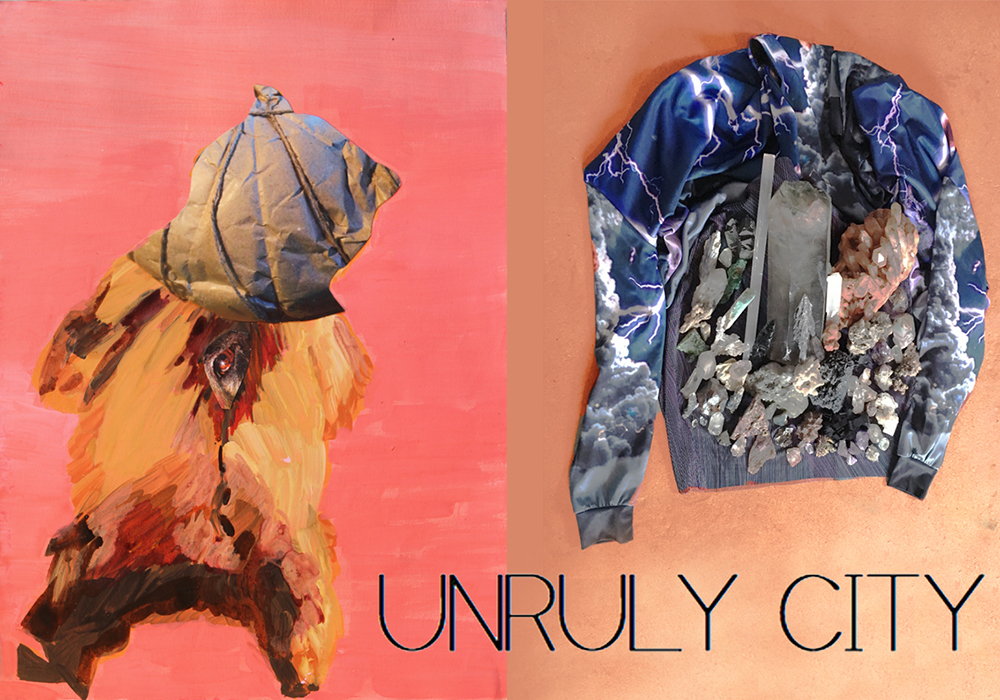
Unruly City :: 2016
Unruly City 2016 running time: 30 minutes 35 seconds
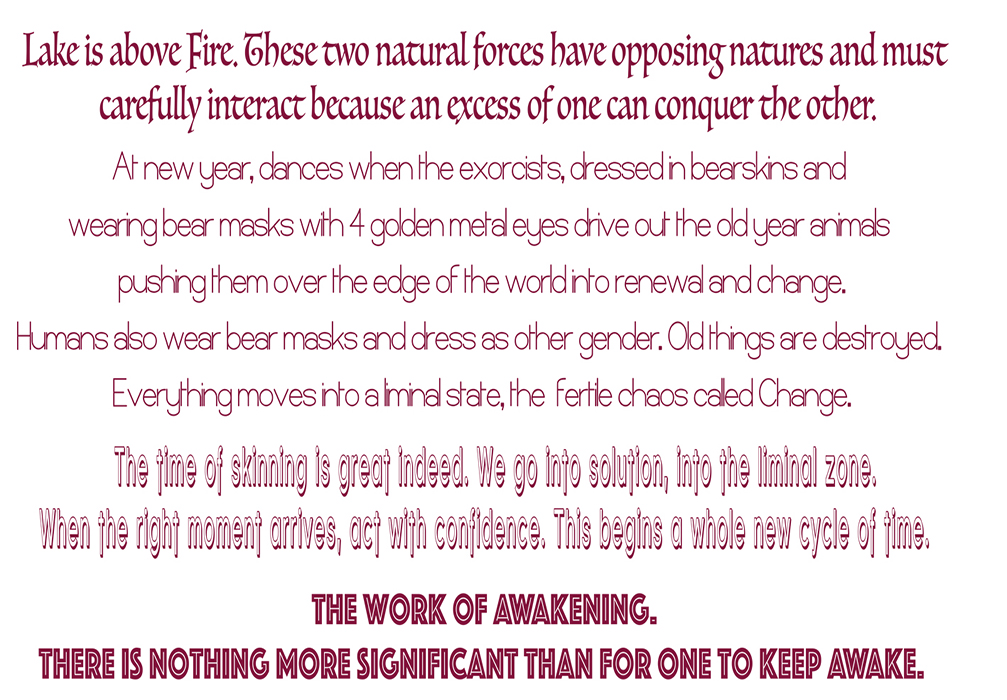
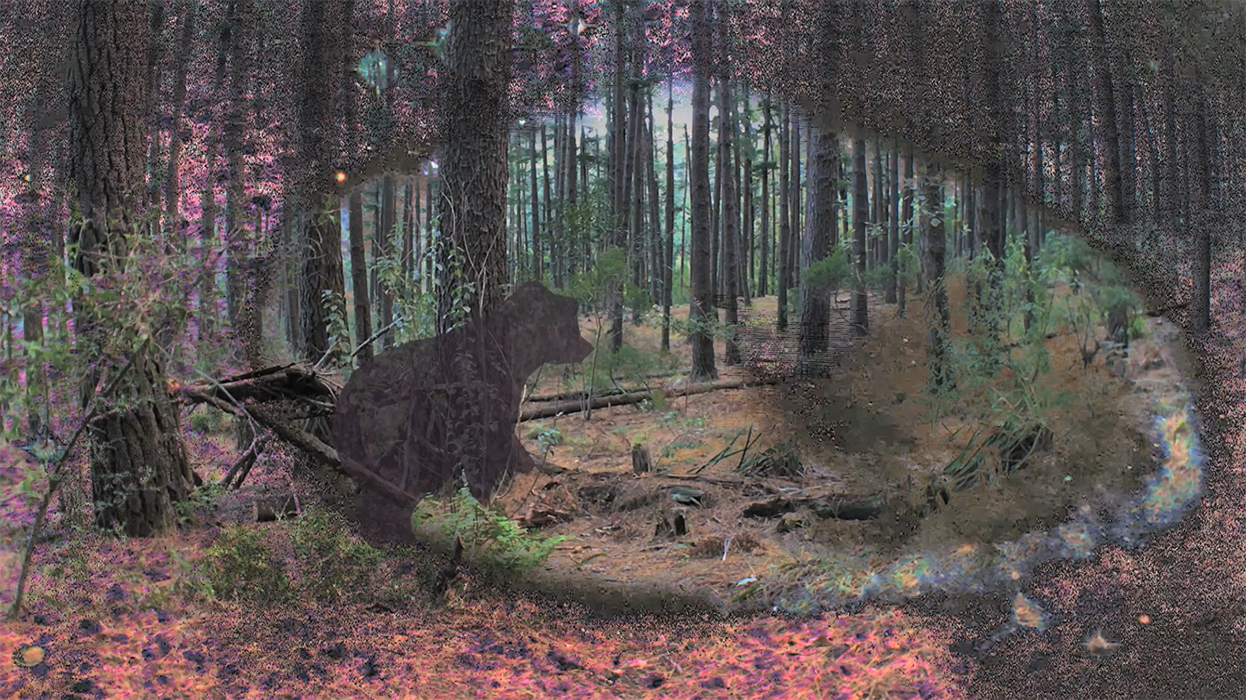
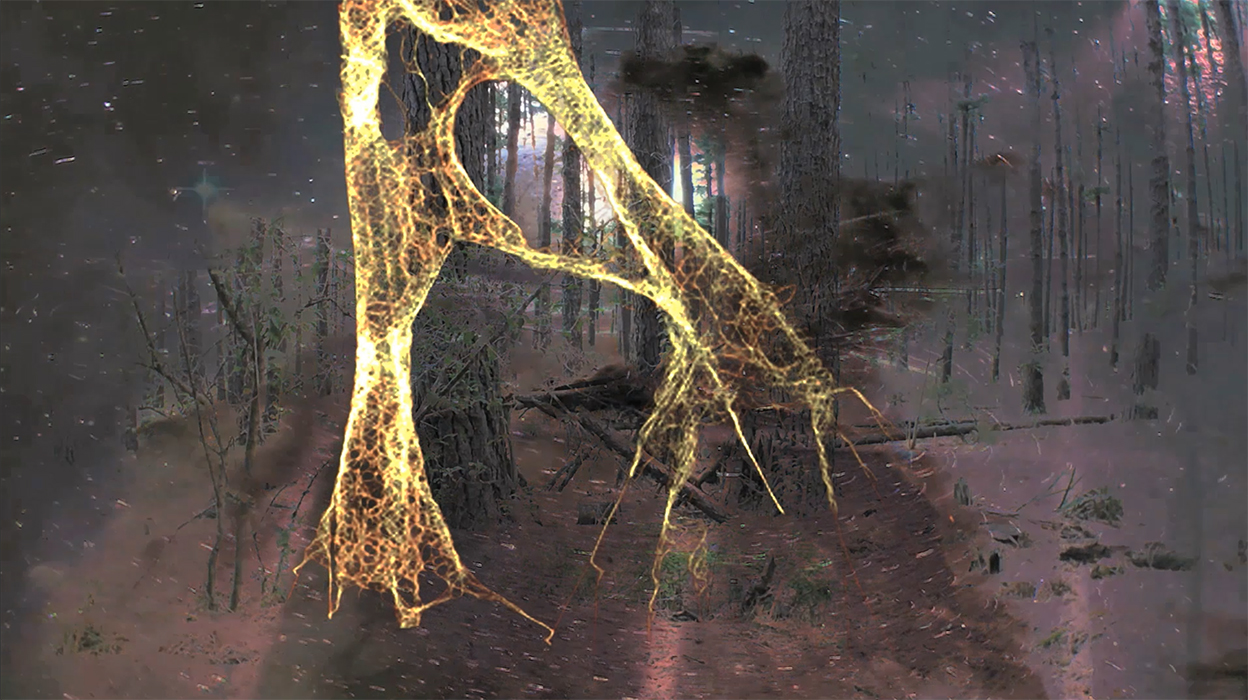
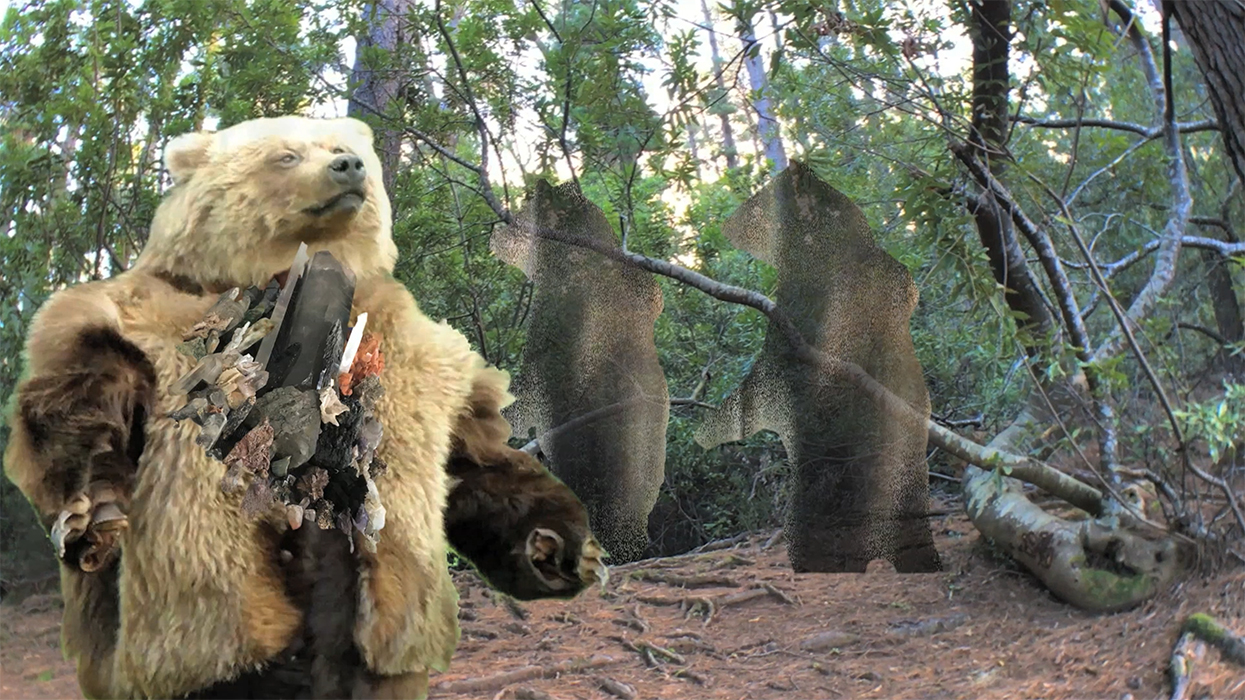
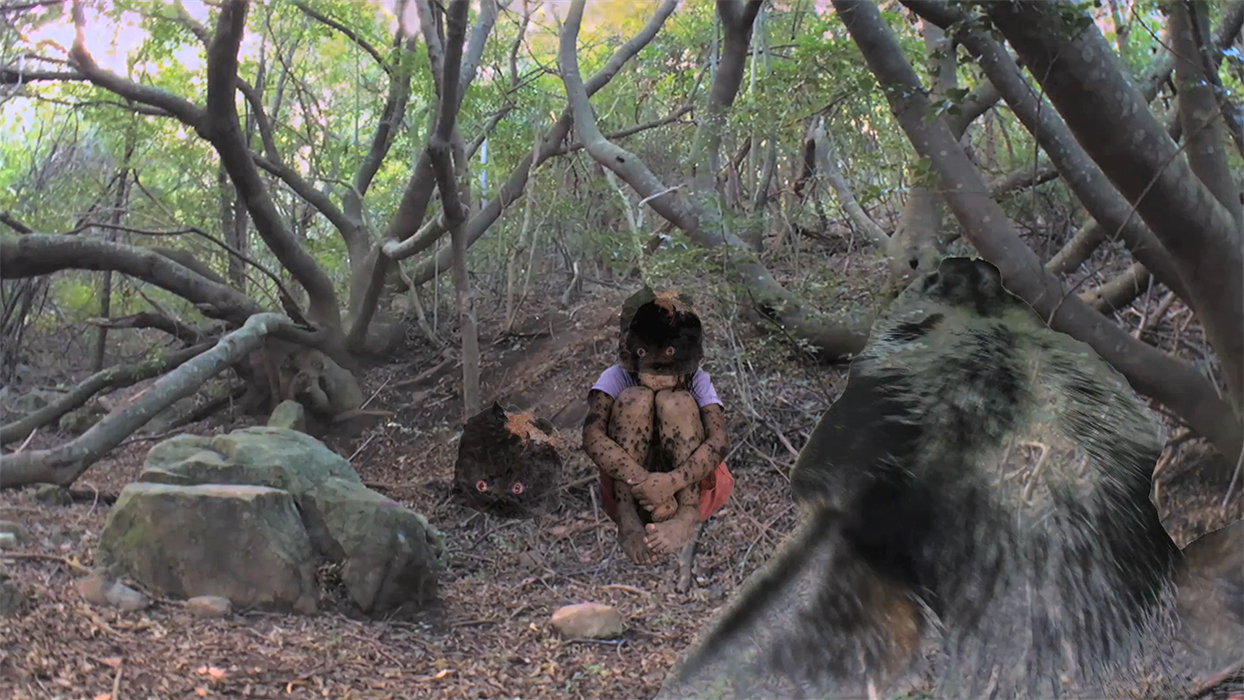
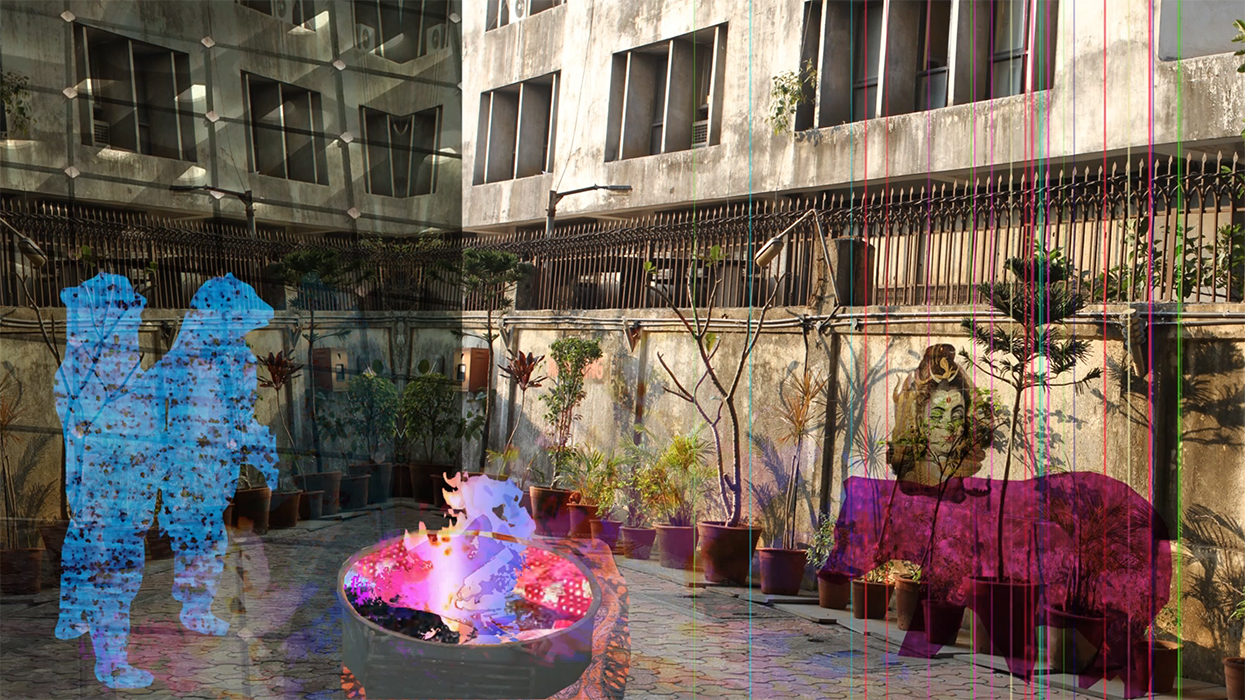
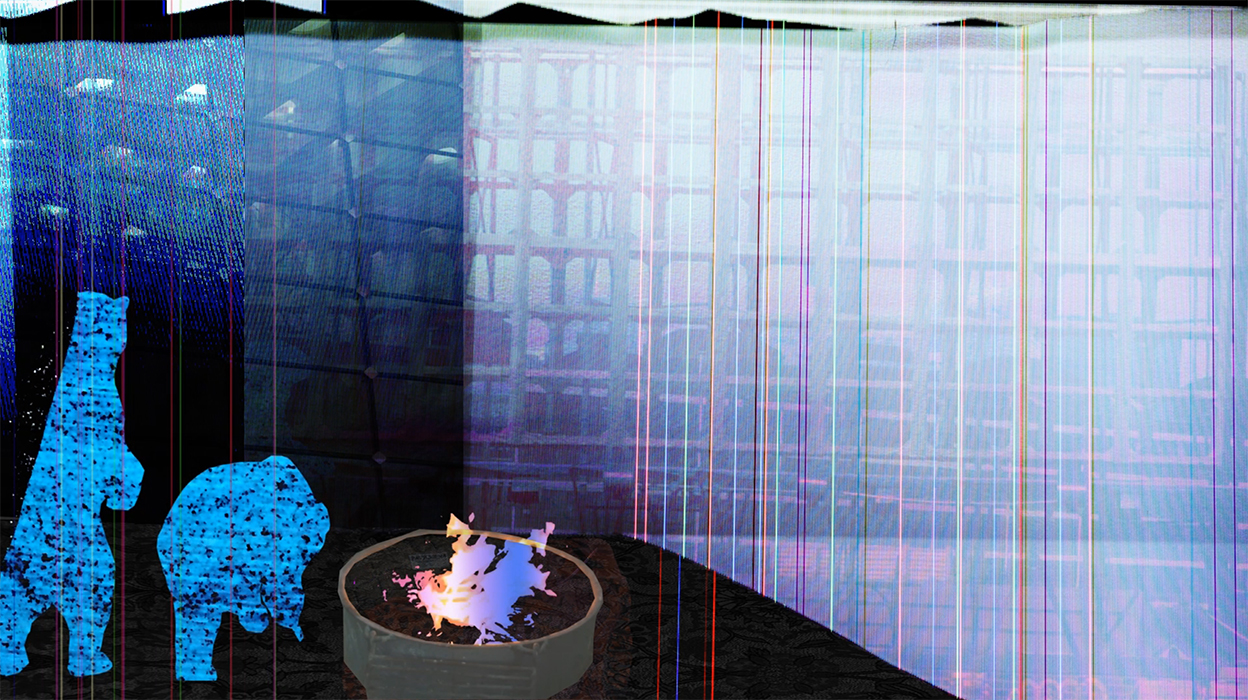
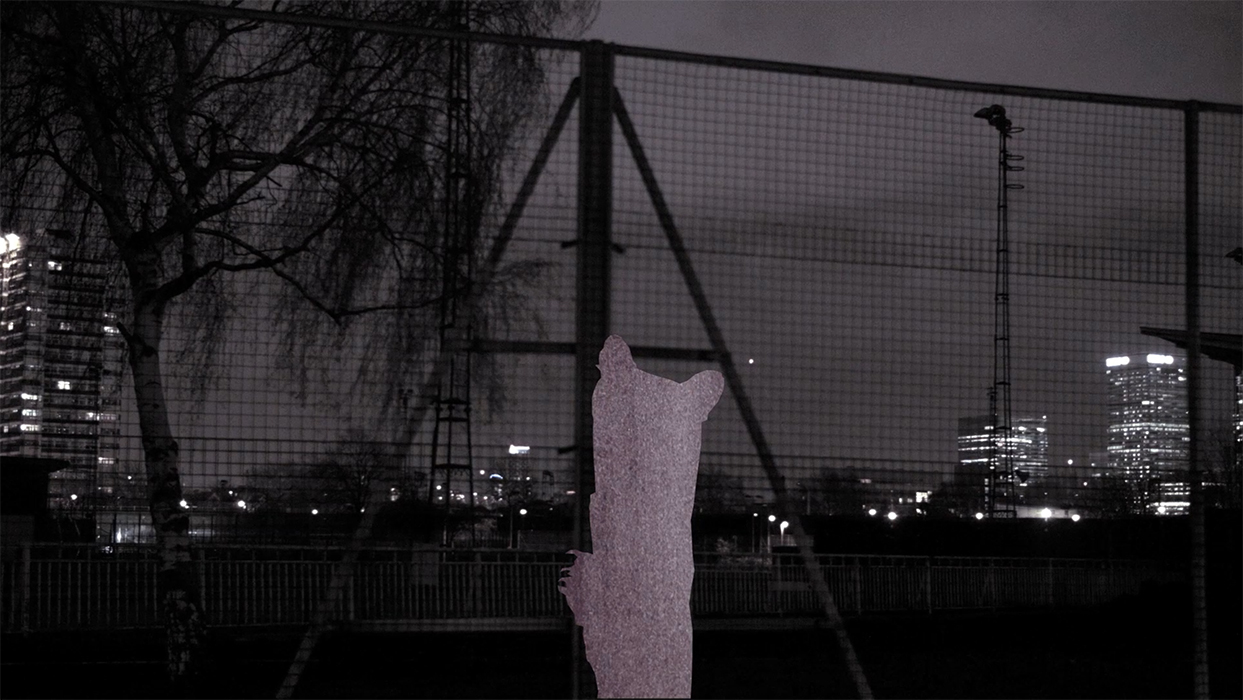
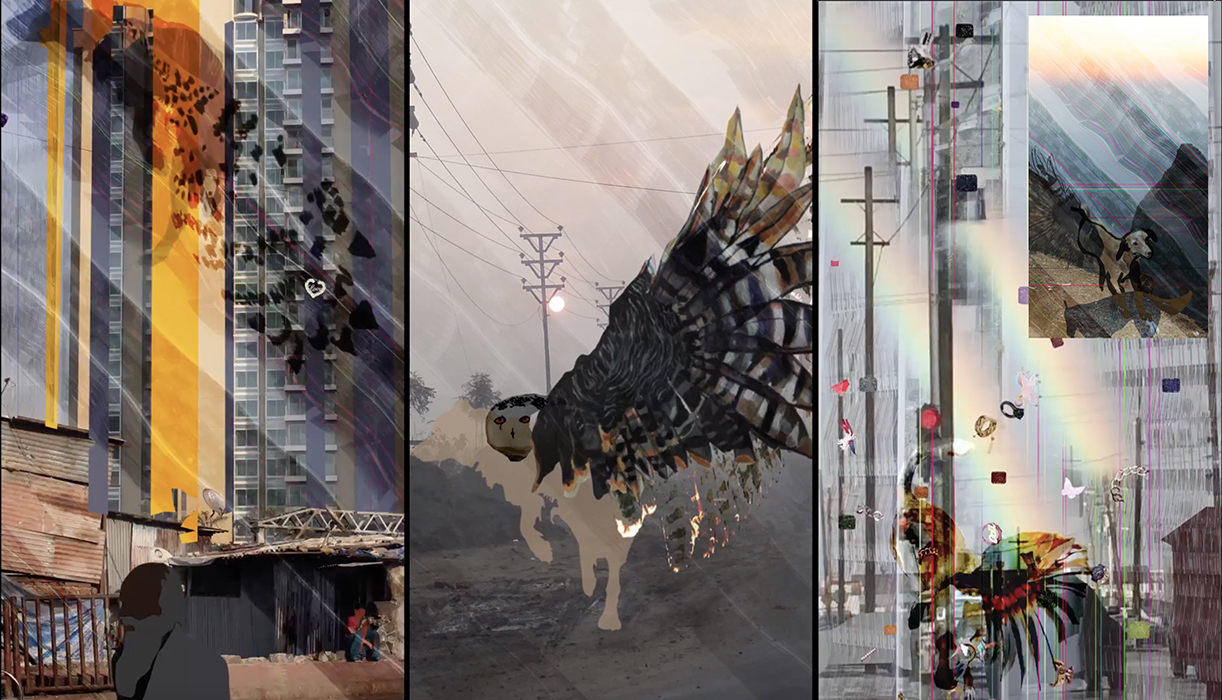
Unruly City premieres segments from a new 0rphan Drift media project, also titled Unruly City, alongside selections of related work by 0D collaborators Ranu Mukherjee and Mer Maggie Roberts. Unruly City is built around Hexagram 49 of the I-Ching, presented to the artists during a reading intended to guide this project. It charts a course through a shifting urban imaginary emerging in the shadow of climate change and bio-capital, creating an amalgamation of potential spaces, materialities and creaturely life.
The first segments of this project bring together densely layered collaged video and animation in a collaborative work by the artists. Treating the hexagram reading as a partial score, these clips revolve around the description of a ritual for the new year: “At new year, dances when the exorcists, dressed in bearskins and wearing bear masks with 4 golden metal eyes would drive out the old year animals pushing them over the edge of the world into renewal and change. Humans also wore bear masks and dressed as other genders. Old things were destroyed. Everything moves into a liminal state, the fertile chaos called Change.” Unruly City is in some way generating a space in which this fertile chaos manifests. 0rphan Drift’s 49, installed in the window at Dold Projects, features elements of Hexagram 49 printed on silk. It marks and defines the space of the exhibition both for entering viewers and passersby.
Segments from Unruly City HD Video running time: 10:00 loop 2016
49 inkjet print on Crepe de Chine 381x 218 cm. (150×86 inches) 2016
Works on paper:
DogOwl1 Ranu Mukherjee ink and pigment on paper 101x 71 cm (40×28 inches) 2016
DogOwl2 Ranu Mukherjee ink and pigment on paper 101x 71 cm (40×28 inches) 2016
Masked Bear Ranu Mukherjee ink, pigment and inkjet print on paper 42x 29cm. (16.5 x11.5 inches) 2016
Running Bear Ranu Mukherjee ink and pigment on paper 42 x 56 cm ( 16.5×22 inches) 2016
Pixel Fire Ranu Mukherjee ink, pigment and inkjet print on paper 70x70cm (27.5×27.5 inches) 2016 Melting Sky Mer Maggie Roberts ink, watercolour and gold pigment on paper 50x73cm 2016
Portent 1.0 Mer Maggie Roberts collage on Venetian marbled paper 2016
Synthetic Experiment Mer Maggie Roberts collage on paper 41x63cm. 2016
Flying Bears and Portal Mer Maggie Roberts collage, laser cut vellum, glitter and fabric on Venetian marbled paper 50×70.5cm 2016
Exorcists and Cross Dressers Mer Maggie Roberts collage on paper 50x73cm 2016
The Time Of Skinning Mer Maggie Roberts Collage, ink, pigment, handmade paper on shiny metallic blue paper 51x65cm 2016
Moonlit Tourists and Fur Jacket Projection Mer Maggie Roberts Monotype. oil paint and silver pigment on paper 45x65cm 2016
Time Travelling Bears Mer Maggie Roberts Monotype. oil paint, irridescent and flourescent pigments on paper 45x65cm 2016
Camo Bodies, Leopard and Hoodies Mer Maggie Roberts Monotype. oil paint, irridescent and flourescent pigments on paper 45x65cm 2016
Holes and Portals Mer Maggie Roberts Monotype. oil paint, irridescent and flourescent pigments on paper 45x65cm 2016
Travellers (Fire Dancers) Mer Maggie Roberts Monotype. oil paint, irridescent and flourescent pigments on paper 45x65cm 2016
Video Works in back space:
Chimeric (dogowl living on the edge of free trade zone) Ranu Mukherjee Hybrid film (dogowl, early morning sun, haze, empty billboard stand, noise, tiara, Bombay/Mumbai, Singapore, San Francisco, London, earrings, hairclips, silk fragments, cell phone towers, magazine clippings, sparkle swatches, rainbow, Lonavala, monkeys, Bandshell, dusk) 4:54:08 loop HD animation 2015
Chimeric (dogowl living on the edge of free trade zone) 2016 running time: 4 minutes 55 seconds
Share
Total
0
Shares
Black Water ghost prescient :: 2015
Black Water ghost prescient :: 2015 Video length: 20 minutes
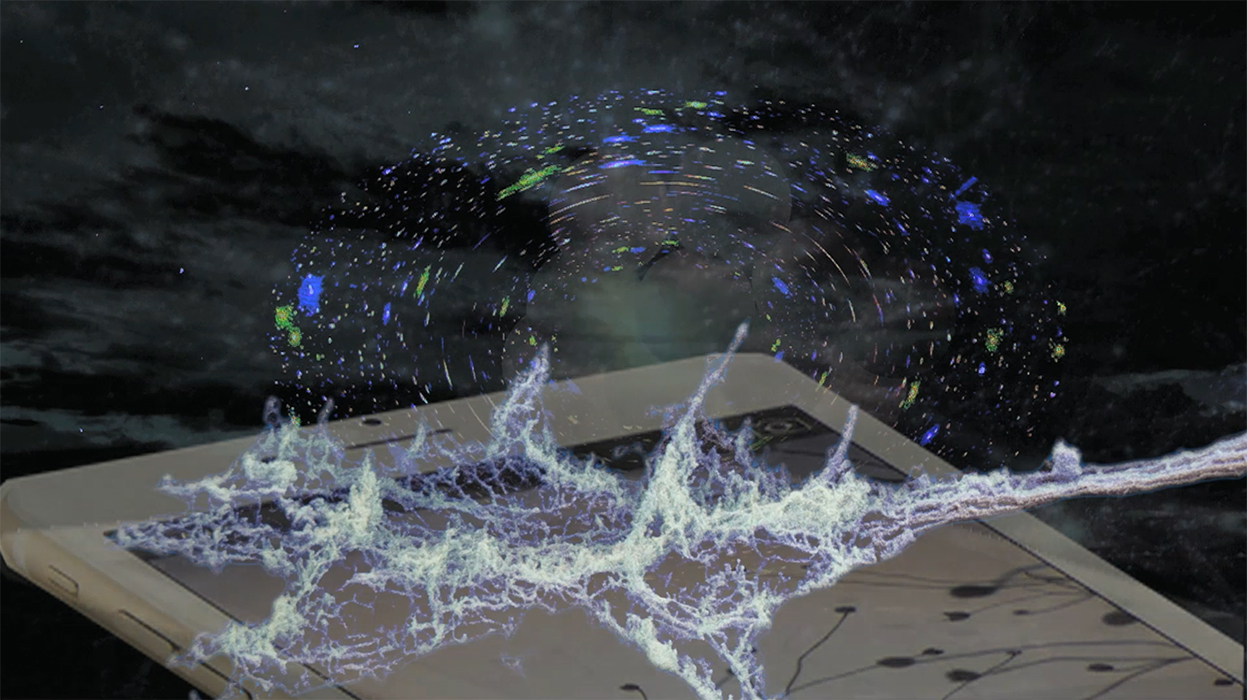
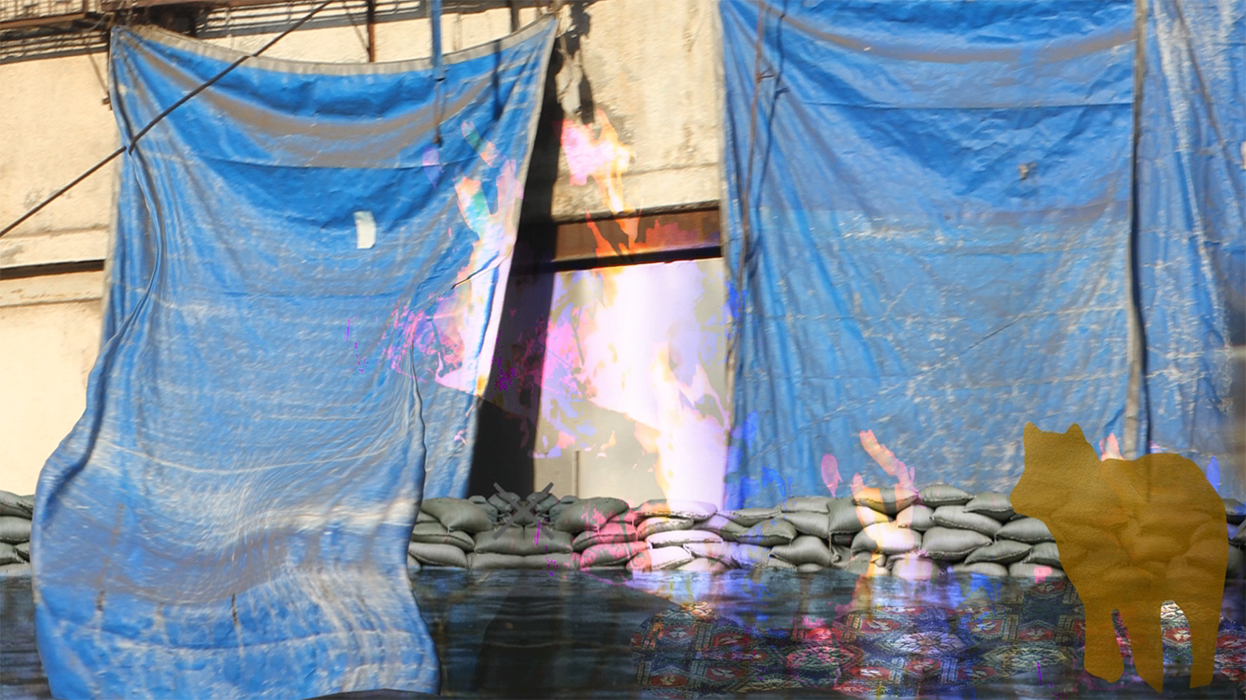
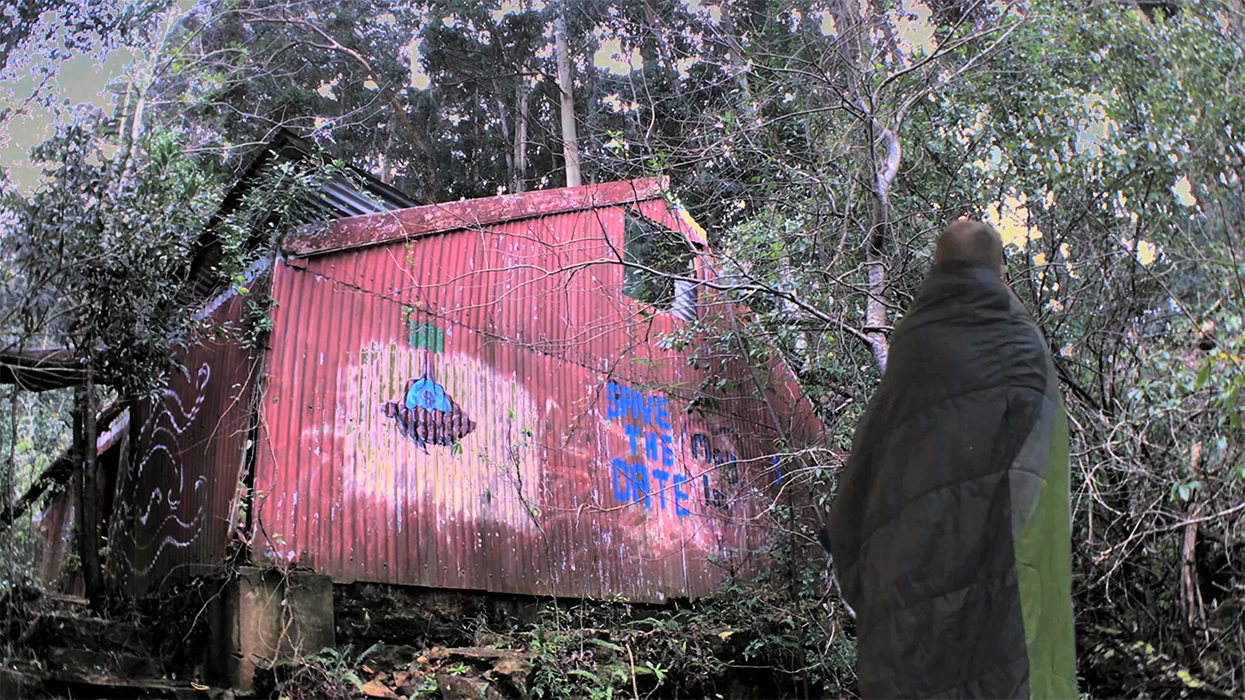
‘Black Water ghost prescient’ amplifies the darkening waters and turbulent ocean of the 2014 ‘Shadow Operators’ video, and explores a liquid future inhabited by ghostly hooded observers.
It is in some ways a beginning for the GIR project, currently in development.
Video and collages by Mer Maggie Roberts, images by Mer and Ranu Mukherjee. The sliver cape and ninja ghosts are Daisy Bogaert and the Hoody, Chris Brehem. ‘Black Waters’ awaits a sound track…
Click on a title below to expand/collapse content
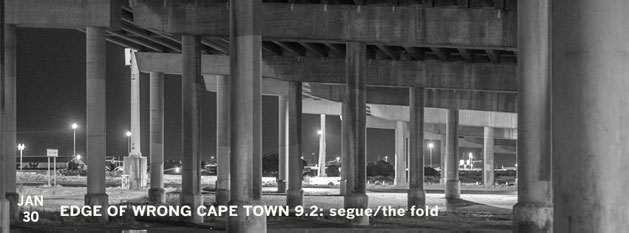
THE EDGE OF WRONG 9.2: segue/ the fold
Jan 30th 2015 Atlantic House 1 Perth road, 7405 Maitland, Western Cape, South Africa
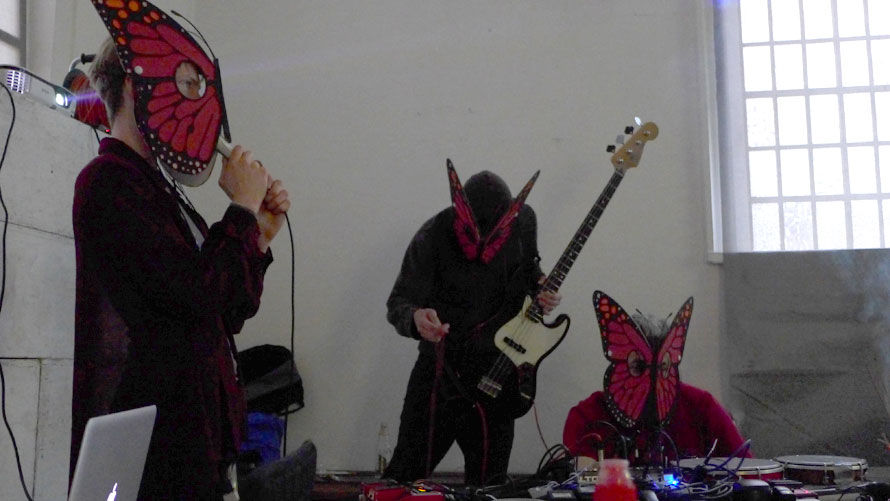
Cello and saxophone improvising with traffic noises under a highway bridge. A performance of Terry Riley’s in C for two laptops. Avant noise electronics. Analogue synthesizers. A postrock ambient drone ensemble with experimental cinematography. Performance art. People playing on obscure instruments, like the blik ‘n snaar.
The ethos of Edge of Wrong is what the philosophers Gilles Deleuze and Felix Guattari call the logic of the AND. Instead of relying on an either/or approach to artistic expression, we choose instead to explore the creative becomings that emerge from unusual, even impossible combinations (or folds, as we’re calling them for EOWct9.2) of sound, visuals and performance. As Deleuze says, “it’s always in-between, between two things; it’s the borderline, there’s always a border, a line of flight or flow, only we don’t see it, because it’s the least perceptible of things. And yet it’s along this line of flight that things come to pass, becomings evolve, revolutions take shape.”
Please join us on Friday, 30 January for our next foray into the pleats, folds and unexpected segues of contemporary music, visual art and performance.
NB: We ask that all guests arrive at 7pm latest as we will be taking a short group walk to a nearby highway bridge for our first performance, returning to the venue at 7:30 for the rest of the evening.
A BIT MORE ABOUT EOW:
HUNTER THOMPSON ONCE SAID that there is no honest way to explain the edge, “because the only people who really know where it is are the ones who have gone over.”
It is a kind of hidden place that is revered and feared by some – the hellish underbelly of the world. Yet it is also a place searched for, written about, and found in the music of the strange. And it is this edge we want to bring to you by creating a space which allows musicians to etch out the edge of wrong, pushing the boundaries so that new sounds might be found.
The EDGE OF WRONG festival is currently in its ninth year and serves mainly to facilitate cultural exchange. Though it has become an established production network it is forever evolving, intent on creating a sustainable environment for quality art of an exploratory nature.
The shadow of the thing arriving before the thing itself.
We have to attend to the impossible stories.
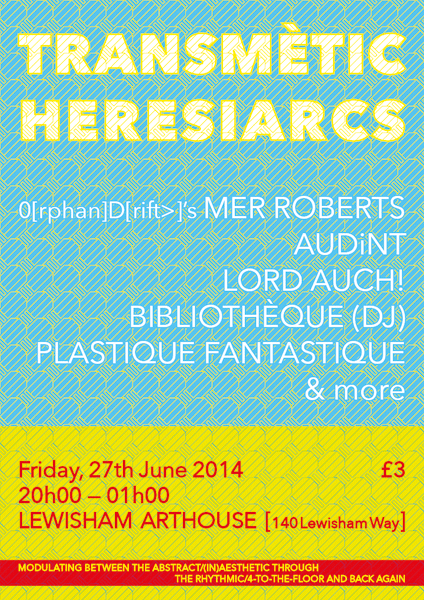
Shadow Operators was commissioned for Sounding The Counterfactual at Goldsmiths College in June 2014. The video was screened with work by AudInt (kode 9’s Steve Goodman) and Plastique Fantastique.
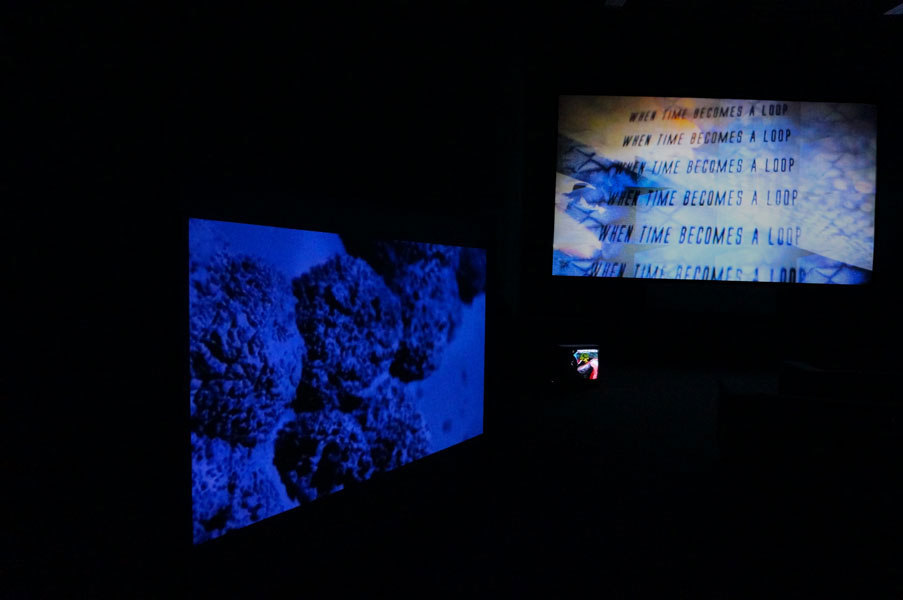
Shadow Operators also screened in the exhibition ‘Schizo Culture’ at Space Gallery, London 2014, along with work by CCRU and Plastique Fantastique then shown in ‘Grotto Heaven’, CAC Gallery, Vilnius, Lithuania. December 2014.
NB. If you don’t have sub bass speakers, there may be a couple of unexpected silent moments in the audio.
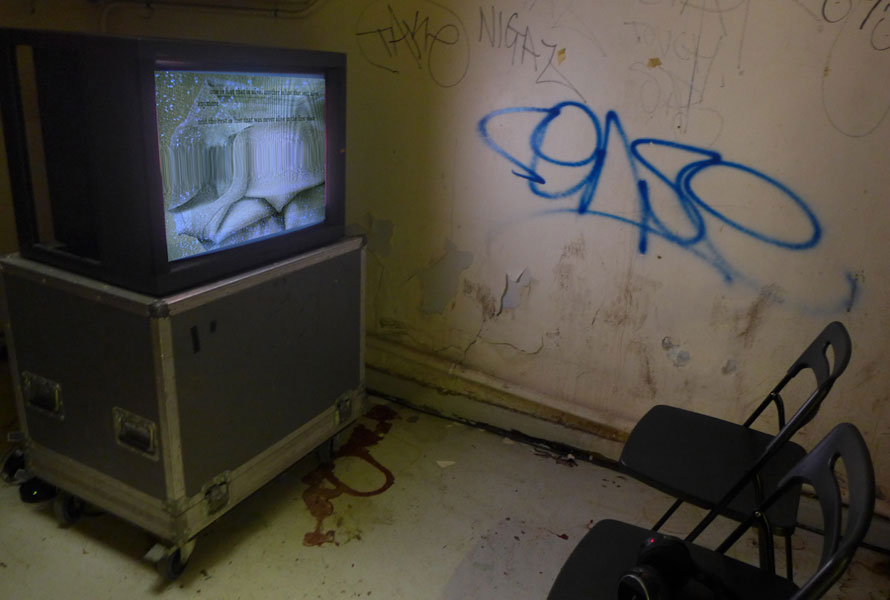
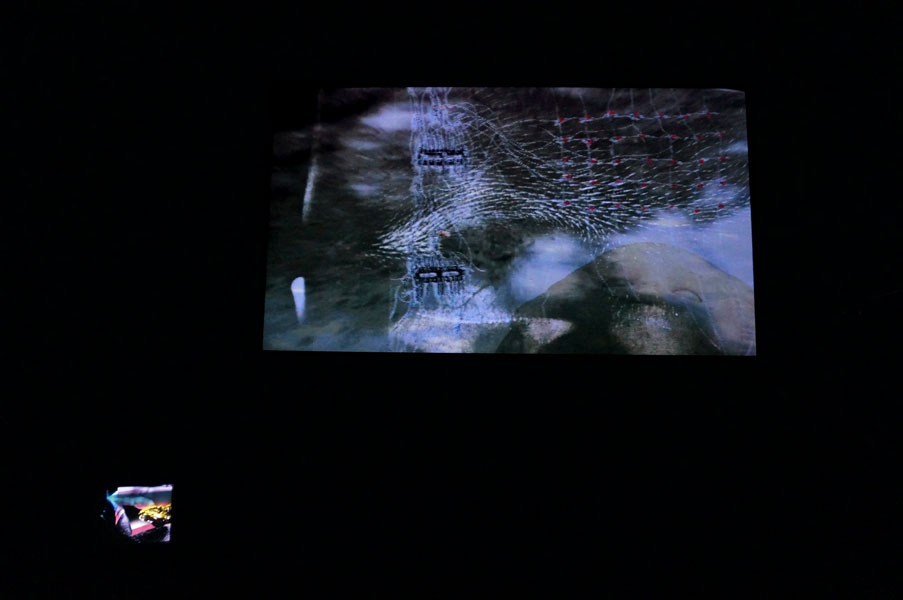
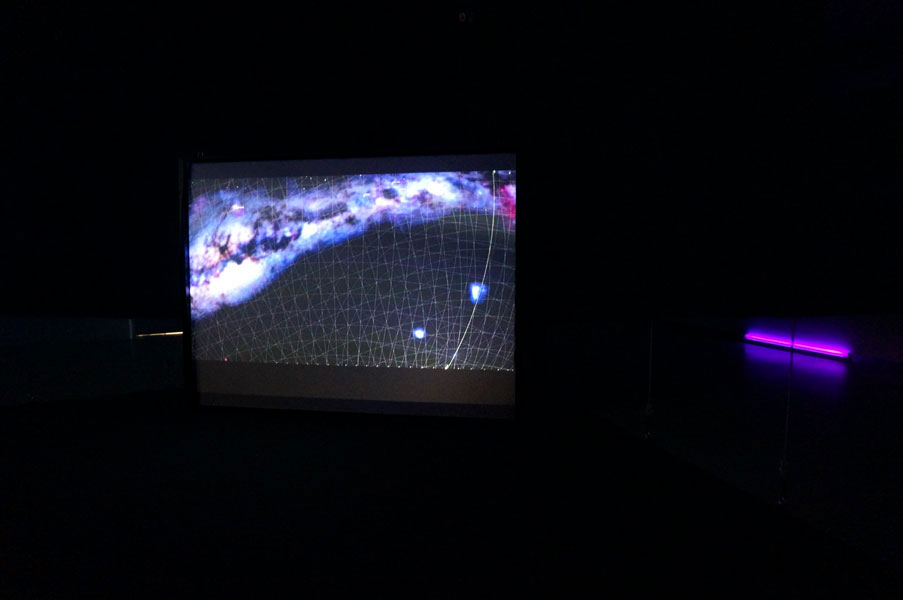
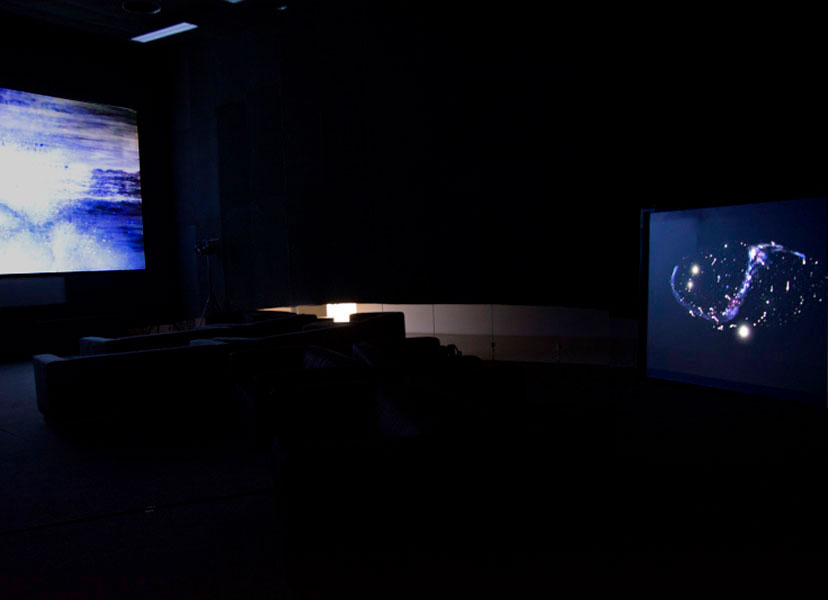
Installation shots, ‘Grotto Heavens’, CAC, Vilnius, Lithuania. December 2014 :: Click an image to expand
Click on the title below to expand/collapse content
SHADOW OPERATORS
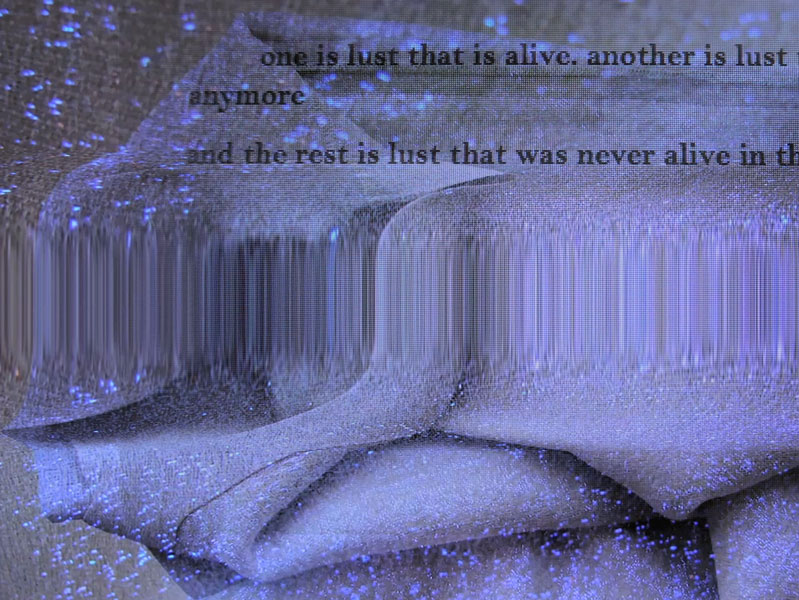
‘Shadow Operators’ is a sensory cross-talk (textual and spoken) of signals from realms beyond the physical, a succession of becomings mimetic, contagious and machinic. These intensities carry the sorcerous forces that technology and science unleash as they delve further into the quantum, the chaotic and the abstract. It is a synaesthetic, chromophonic work where trembling textures respond to the immersive soundscape. (Sub bass may not be audible, depending on your speakers). Collage imagery is embedded in the flow, reflections on 21st century hyperstitions. Suspension, overproximity, over exposure are tactics with which to dismantle the focused gaze. The liquid canvas conveys a space of infinite possibility and intensity, both a turbulent ocean and virtual entity. The work maps devices that operate between the finite and the infinite, the complex and the linear. Hyperstition is driven by speculation, trends and hype cycles that are culturally producing apocalypse. The Mechanosphere, the Anthropocene – the pace of technological and socio-economic change has amplified speculation as to where history is taking us. Accelerated superstitions have very real consequences. Technology has revealed the immense and un-human time scales of cosmic, geological and biological evolution, the existence of dark materials and energies, existence of further dimensions, the very mechanisms of matter and life. The ocean, filmed in myriad states of turbulence, then heavily and cumulatively effected, forms an abstract medium in which to embed these influences. The overall intention with this piece is to conjure an intense beauty with toxic reverberations that produces future shock and yearning for immersion in the viewer.
Shadow Operators explores the feeling of Hyperstition as an affective frequency. The current version is an audio and text driven work. Text is both embedded in the visual field and a spoken presence in audio.
Like A Wilderness Of Elsewheres, Shadow Operators consists of five sections, each with a distinctive frequency, audio and image content, here based on the elements of contemporary Hyperstition science fiction. Catastrophe, transformation, forge. Sound as a way to travel.
Perhaps we imagined the earth’s processes were linear… Habitat destruction, over population, over harvesting, pollution, ozone destruction, all are non linear. And work on each other in non linear ways.
The visual canvas is an intensely effected series of complex and increasingly turbulent fluid states which originate in close up footage of ocean movement, its rhythms and textures abstracted from their source and rendered virtual in substance, tactile, viscous. The sensation is of being overwhelmed by and dissolved in quantum currents, chaotic fields of the electromagnetic spectrum.
The text is generated from 0rphan drift performance and publications, my notebooks and Delphi Carstens Hyperstition phd. It becomes a shimmering embedded layer by being refilmed off a screen. Sampled documentary and scifi clips are similarly treated so that these elements merge with the fluid canvas. Allocated video filters applied to each section create a distinct artificial frequency. Content reappears mutated, transformed in temporality, direction, scale, opacity by the effecting presence. Hyperstition is a dimension of flux, a manifestation of the invisible and collapsed temporalities. It highlights uncanny, unpredictable patterns and attractors: proliferations and die backs; storms, heatwaves, tsunamis, dust and wind, weather as monster; super bugs; excessive capitalism, radiation clouds from Fukushima, mercury levels in fish. This uncanny is also temporal – time oozes and undulates, concertinas and spreads. Events are always already happening. They are demonic in that through them causalities flow like electricity. Such vivid intimacy and a concomitant unreality. The intensity of their traces are unreal in their very luminosity. This searing clarity presents as clear unaffected photographs and collages that float on, rupture the dense textural ocean.
SOUNDING THE COUNTERFACTUAL: HYPERSTITION AND AUDIAL FUTURITIES @ LONDON CRITICAL
Stream organizers: David Cecchetto, Marc Couroux, Eldritch Priest
London Conference in Critical Thought, June 27-8, Goldsmiths, University of London.
That sound and affect are fatally entangled should be obvious, for they share a primordial relation to a zone of indetermination between unconscious bodily impingements and their selective, conscious actualization. This is further suggested by the way sound’s im-mediacy and hearing’s continuous intake figure audition as a amenability to influenza of various forms that nudge virtual potentials towards predetermined outcomes. For contemporary cybercapitalist power, sound’s affective/infective nature plays a key role in ratifying its need to preserve homeostasis through a negative feedback that holds matter and information as equal realities. According to Anahid Kassabian, in a world of ubiquitous, networked technologies, music and sound are crucial vectors across which distributed-informatic subjectivities are constituted, a position advanced by the third wave of cybernetics wherein machinic, mediatic, and prosthetic ecologies have become indissociable from biological processes. Indeed, within this human/non-human commingling control operates virtually, nested within affective states that “unfold the past into the present” and inflect “the way the present acts on the past to unravel a new future.”
Hyperstition, a term coined by the Ccru (Cybernetic Culture Research Unit) and most often attributed to its chief ideologue Nick Land, is a useful point of intervention within a system that suppresses contingency, futurity. According to Land, “hyperstitions by their very existence as ideas function causally to bring about their own reality…transmuting fictions into truths.” Such a formulation is exemplified by finance capitalism’s investment in fictional entities such as futures and derivatives to compose an abstract but no less real dimension of profit. However, the manner in which the power of the virtual has been exploited by inhumanist capital to bring about the reality of a speculative profit—as in branding’s sorcerous implantation of false memories and future desires, which rewire the very notion of lived experience—points to the promise of hyperstition as producing counterfactual lines of actualization that compel the world to unaffordable futures.
How might sound (noise = rumore (It.) = rumor), the virological, immanent medium par excellence—acoustic space as networked space—be productively leveraged for its capacities to induce, bend, and channel affective potential? How might the effective powers of fiction be sonically enacted? How might spatial redistributions of mobile electronic sound galvanize emergent social and political structures?
Papers that grapple with these questions are welcomed, especially (but not exclusively) pertaining to the following areas of investigation:
– Science-fiction scenarios productively intermingling sound and futurity.
– The relation of sound to virality and emergence: how the molar might be engendered by the molecular.
– Technological prosthetics: how an alien phenomenology might be sonically leveraged.
– Sound and neurological processes: psychoacoustic neuromarketing (audio branding), priming, etc.
– New forms of listening (distracted, marginal, algorithmic, molecular, paradromic, pareidolic, machinic, infrasonic, telepresent) fostered by distributed, networked technologies.
– Techno-magical operations: confluences between occult procedures and bleeding-edge technologies.
– Rhythmanalytical modalities in algorithmic, computational cultures.
– Sonic accelerationism: auditory catalysts to induce alternative modernities and new socio-political formations (swarming, crowdsourcing, local-global transversals, viral processes).
Music’s amenability to cybernetics is underlined by Claude Shannon, who defined a “singing condition” as the inability of an automata to recognize its loopy entrapment. Music’s particular affordances, vitalities, and teleological necessities could serve as a model to help ensure a preordained future through the transformation and regulation of extra-musical sound, channelling the impersonal, inhuman death drive (positive feedback) into homeostatic equilibrium (negative feedback). Noise, far from being a nuisance to such cybernetic systems, is in fact essential to periodically restart them. How might an effectively transgressive practice operate given the alien, invasive neuro-military-entertainment avant-garde; what hyperstitional, paradromic methods might hijack and mutate uncommitted affective excess, escaping the reach of capitalist territorialization? This event is intended as a conversation probing the multifarious linkages between music, affective modulation and chronoportation.
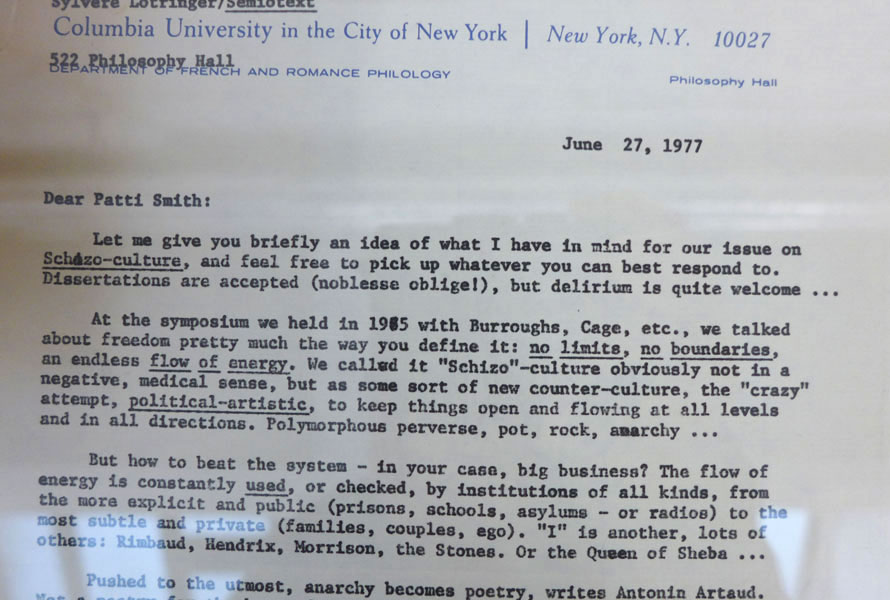
SCHIZO-CULTURE – CRACKS IN THE STREET 03/10/14 > 07/12/14
SPACE is proud to present an exhibition and event series taking the seminal 1975 event: Schizo-Culture: On Prisons and Madness as its point of departure.
Organised by the early Semiotext(e) group – then comprising Sylvere Lotringer and John Rajchman – whose mission statement was to ‘bring together two continents of thought through a revolution of desire,’ the 1975 Schizo Culture conference saw counter-cultural icons such as John Cage, William S. Burroughs, R.D. Laing and Ti-Grace Atkinson come head to head with figures now regarded as some of the most influential thinkers of the 20th century: Michel Foucault, Jean Francois Lyotard, Gilles Deleuze, and Felix Guattari.
Cracks in the Street will feature new exhibition and performance commissions by Silvia Maglioni and Graeme Thompson (Terminal Beach), Sidsel Meineche Hansen, and Susan Stenger, alongside recordings and ephemera from the original 1975 event and the Semiotext(e) archive (courtesy of Fales Library and Special Collections, New York). Also featuring contributions by 0rphan Drift and Plastique Fantastique.
Curated by David Morris and Katherine Waugh in collaboration with Paul Pieroni/SPACE. Supported by Arts Council England.
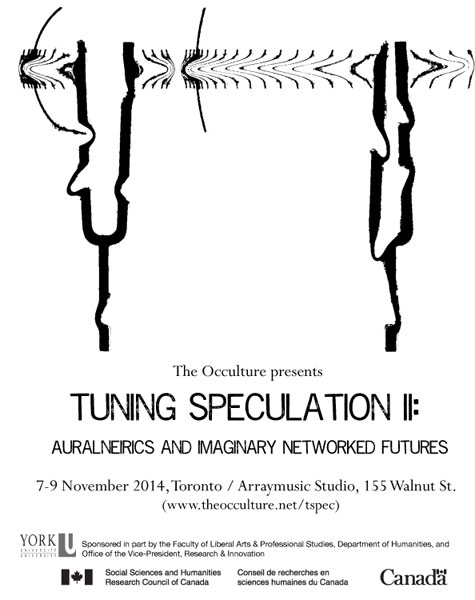
The Occulture (David Cecchetto, Marc Couroux, and Eldritch Priest) presents:
Tuning Speculation II: Auralneirics and imaginary networked futures
7-9 November, Toronto (Canada) ARRAY space, 155 Walnut Avenue
Plenary Speakers: Frances Dyson, Nandita Biswas Mellamphy and Dan Mellamphy
In the context of ubiquitous media not only is the sheer volume of data notable, but so too are the ways in which we encounter, interact with and articulate its abstract mass. This is particularly significant where contemporary social experiences are increasingly interpellated by a technical apparatus in a way that makes the former available only through the invention and deployment of extra-sensory algorithms. The implication of technology in human activity (while always present) in this instance raises new challenges, for the algorithmically negotiated data-bloom of digital networks intensifies the problem of agency by distributing its expression across material and virtual domains that belong to both organic and inorganic systems, as well as actual and fictional entities.
Building on last year’s meeting, this three-day workshop seeks to examine how aurally inflected mediations might address the complexities of agency and its relation to the counterfactual when one’s actions, feelings, thoughts, competences, desires, failures, and daydreams are implicated in the self-adjusting operation of nonlinear networks. For instance, we are interested in the ways that aurality conjures alternative sensitivities to data flows and rhythms of change that allow for both increased agency in existing networked settings but also for the envisaging and summoning of new vectors of agency itself. While several approaches can catalyze such speculations, we propose to concentrate on sounding art—broadly understood—in order to leverage the fated semiotic parasitism, differential production, relational expression, and perceived multiplicity that informs such practices. However, alongside such concentrating we also welcome various reflections on sono-distractions, phonochaosmosis, rhythmanalysis, harmelodic-prescience, audio pragmètics, chronoportation, h/Hypermusic and other invocations of impossible and/or imaginary networked aural futures.
Participants: Mitch Akiyama (Can), Lendl Barcelos (UK), G. Douglas Barrett (USA), Marcus Boon (Can), Geraldine Finn (Can), Paul Hegarty (Ireland), Ted Hiebert (USA), Eleni Ikoniadou (UK), Jonathan Scott Lee (USA), Nicola Masciandaro (USA), Svitlana Matviyenko (Can), Magdalena Olszanowski (Can), Ashley Scarlett (Can), Nikki Cesare Schotzko (Can), Marcel Swiboda (UK), Doug Van Nort (Can), Michael Vertolli (Can), Alexander Wilson (Can), Scott Wilson (UK), Martin Zeilinger (Can).
Special performance Saturday night, 9 PM : Paul Hegarty and Guests!!!
The entire three days will be streamed online. Live tweets will appear throughout the workshop under @xenopraxis. Stay tuned to The Occulture for details.
All welcome!
Marc (for the Occulture)
GROTTO HEAVEN PRESS RELEASE
A videoscape by Margarida Mendes with works by 0rphan Drift, Jol Thomson, Nate Boyce, Diogo Evangelista, André Sousa, Serafin Álvarez, Laleh Khorramian, Trygve Luktvasslimo+Fredrik Strid.
December 2014 at CAC Cinema
As the winter darkness peaks, visions of possible futures announce themselves: deteriorating cyber-landscapes collapsing into erupting lava, occult planetary formations merge into new data-matter systems, encrypted scenarios emerge as coral-like structures; sulphur and sweaty hardware.
This event takes the format of an ambivalent wonder.
While drifting through immersive world views and celestial formations, a polyphony of voices disclose epidermal plateaus and disassembled neuronal systems. Cells mutate and transform into new entities, infinitely consumed by their own metabolisms. Decomposed minerals are rewired into new interchangeable units. The nerval subtraction of the skin deteriorates into drinkable liquid. Cosmology reiterates itself and existentialism is molecularly navigated.
Grotto-Heavens is the first act of a series of events included in Catastrophe Cabaret, a programme speculating about possible futures in an era of predicted extinctionism. Contesting the general pessimistic view that dominates the topic, this project takes the overlap of absurdism and science fiction as an essential catalyst working towards self-representation, leaving us with the following qualms:
How do we envision our bodies in the unforeseeable post-catastrophic material world?
How will we choreograph the cognitive sensoriality of the future?
Margarida Mendes has directed The Barber Shop project space in Lisbon since 2009. She has a Masters in Aural and Visual Culture from Goldsmiths College of Arts in London. Specific research interests include materialist philosophy, cybernetics and experimental film.
“Grotto Heavens” is a contribution to the programe of events of the pilot project of the XII Baltic Triennial, “Prototypes”.
Share
Total
0
Shares
Cyberpositive Relaunch :: 2012
In 2012, the future this book was projected from, this book was re-launched by the Cabinet Gallery “to acknowledge a legacy and a history, but also the enduring relevance of the work”.
This edition includes a new introduction by Suhail Malik. Accompanying texts by Nick Land Maggie Roberts and Delphi Carstens were also produced towards future editions. Copies are available from the Cabinet Gallery, London.
It would be a mistake to see this publication as a re-issue, for two inter-related reasons: 1. in its forceful alienness the text, which may or may not be a book, proscribes it; 2. we are now at its terminal date. To be emphatic, already: a proscription, not a prohibition; termination, not expiry.
Why both? Because this ‘book’ – which format is only a temporary, internally insufficient holding pattern for what it might (yet) be – anticipated the ubiquity of cut & paste not only for writing itself – taken now to be only some kind of organization of text, information, code, of text as code – but also as the very operator of the currency of the present in the circulation of tweets, texts, blogs, likes, +1s, and the rest of it.
What’s news? Whatever pasted link arrives in your device.
A past link: By the dog-end of postmodernism the humanist banalities of creation and subjective expression had been effectively discredited (though they have been unfortunately revalidated through the regressive theoretical, political, economic and cultural fightbacks of the late-1990s and 2000s). This proto-book fleetingly captures a moment in which these dismal legacies of humanism are rightly treated with a castigating disdain if not outright revulsion (such is its fatal anthropism). Doing so, it no less effects and cleaves the now ubiquitous processes of transmission, relay and recoding to index the stark invention wrought by these coded-communicational systems and structures, not us. Whatever that might be, what might be generated on the other face of such a revulsion, was tested and instantiated by – as – this quasi-book, even as it perspicuously thematized the necessity of its own assembling. In other words, confronting the question in 1996, it asks: what is new about now? Now, 2012? What else happens that was not already set in place in 1996?
Link ahead: Determined by various end-time configurations and logics, 2012 is the peril- date of this book-assemblage. This year – this year – was far enough away from 1996 to be at the outer edge of its extended present, a perpetuation of the then-given that could nonetheless touch on its fantasmatic limit, and yet close enough to hold an imminent threat to that very anticipation. 2012 was a threat and alteration close enough to have to pay attention to, that might have been emerging even as it was being composited. A future that could be something else to what then was but which was nonetheless closeby; a looming something else, its peril or elseness an imminent threat. The shadow of nuclear obliteration inverted.
Unlink: That predatory-alien threat was declared, enacted, composited, (de)coded, felt in this quasi-book in 1996 as in much of the cultural production it remobilizes. The reality it presented of a transmission system preoccupied with its circulation as much as with anything that it could convey from outside of that systemic organisation – for example, expression, the bewildering range and subtlety of the affective range of complex primates, previously rhapsodised by poets now effectively parsed and coded adequately well by the stuttering, finger-spasming proliferation of LOLs, OMGs, and emoticons – these irruptions of a code syntactially organized for its own convenience, replacing the speech of subjective singularity, is precisely indexed by this book-assemblage. What irrupts? The very mechanism and system of communication generating and articulating in the process its own counter-force to the human predominance over meaning and semantics. An exposure to something else than that circulation coming now from within the technical parameters and ubiquity of written- coded communications. Tremors registered if not expressed from the outside to any anthropic history or subject in the circulation and honing of a syntactically-crashed semantics. Not obliteration but transmission prevalence. 1996 is the end-time, this book our forceful because necessarily asocial precursor.
Attachment: What this book-assemblage presents, what it understands, affirms and demonstrates from long-enough-ago to be a just-far-enough-away history of our present, is that cut & paste’s deracination of meaning from context, site, production, need – an ontological deracination – are the truth of communication. It presents evidence of that truth, sometimes vaguely recognised, sometimes more emphatically so, as its composition. More so: it’s the truth of a communication system decelerated enough for its capture and retransmission by the nervous and symbolic systems of a large number of complex primates, enough of whom are deployed in/by it to not unduly retard either its global refresh rate or refinement; a system that advances your alienation from your own semantic security as you reproduce and disguise its syntactic irruption with the fantasy of your own intimacy.
Suhail Malik
0(rphan)d(rift>) Cyberpositive
‘It is happening again…It is happening again…It is happening…’
-POSITIVE FEEDBACK ENGENDERS CHANGING CONDITIONS THAT MOVE AWAY FROM EQUILIBRIUM, GIVING RISE TO ADAPTIVE STRATEGIES. EVOLUTION AS SYSTEMATIC AND CYBERNETIC – NOT A QUESTION OF UTOPIAN RE-ENCHANTMENT BUT SIMPLY OF SURVIVAL, IN ANY DIMENSION, SHAPE OR FORM.
-hooked / hooks for the future as approaching singularity / addiction /retroviral feedback / physically reconfigured / virally positive.
-synaesthesia, virtuality. The virtual explored through audiowaves, psychoactive situations, electro-visual stimuli. Somatic responding, seeking contemporary navigational tools.
Cyberpositive begins as a text collage to an installation by the multimedia art collective 0rphan Drift at the Cabinet Gallery in 1994. The insistent signal that became Cyberpositive transforms into an anomaly from the unknown, unequivocally in control of its own arrival and composition. Early 1995 it emerges as a science fiction experiment that traverses the alien urban landscapes and affective experiences of hyperreality, continuously in the process of being mutated under the spectral glare of information technologies (many of which it anticipates). The synaesthetic, addictive, polyrhythmic and vampiric potentials of cyberculture are meshed through a barrage of machine code populated by AI and voodoo frequencies. Its dynamically visual narrative is something at once prose, image and drug; making a story of a process of seduction for the K-strayed generation.
There is an ‘author’, or rather originator, assembler, plagiariser and psychogeographer – Maggie Roberts (Mer 0d) – who serves as channeller and choreographer for the leakage of text flowing from the distributed artificial consciousness. The book is a diagram for 0D’s hive-mind process with which many of the asked (the four core and various transient 0D collaborators), and un-asked contributors identify. The methodology is the text; no metaphor but direct immersion. Self disassembly allows a channel to open onto shapeshifting data flow and static coated complexity, dissolving the authorial voice into moebian circuits of digital alchemy.
0D happens to its members as the author is written by its sources. Individual identity is subsumed in a radical experiment with artistic subjectivity to produce a singular artist/avatar which uses the sample and remix extensively, treating information as matter and the work as a unit of contagion. Cyberpositive (the show at the Cabinet Gallery and the book) is the first public statement by the collective artist – a kind of manifesto and a shedding of habits. The swarm-text format is informed by and includes pre-Cyberpositive collaborations between 0D’s Roberts, Ranu Mukherjee and Suzi Karakashian. It draws on the gothic materialism of Nick Land. It penetrates the work of the CCRU (Cybernetic Culture Research Unit), particularly its Abstract Culture Journal to which its various members and affiliates (Land, Steve Goodman, Mark Fisher, Ian Hamilton Grant, Kodwo Eshun etc), contributed. It combines radical cyberblitz theory with fictional prose elements; a techno-aesthetic of voices gathered from the streets, abysms and luminous aethers. It is formatted as a manifesto for cyberpositive (r)evolution.
The idea that the processes and products of the information age may be catalyzing a new evolutionary becoming is one of the central ideas not only of Cyberpositive, but also of its cybercultural predecessor, DeLanda’s seminal War in the Age of Intelligent Machines which develops Mcluhan’s theme of humans as sex organs for the machine world. As cybercultural theory-fiction, written by a robot historian in the future, War In the Age was an early salvo on the implication of the rise of digital networks. Cyberpositive is another such salvo, exploring similar consequences from the perspective of a radical affectivity.
Throughout Cyberpositive, theoretical and fictional samples are phase-shifted into affective territories in the same way that DJs perform a kind of motion capture to virtualise sampled sounds. Science fiction and contemporary machine music both activate the somatic intensification of experience; the latter acting as a type of sensory engineering that mirrors the way in which literary SF amplifies the experience of technological overload. Cyberpositive fuses them, employing different frequencies and overlapping rhythmic patterns to activate submerged regions of the brain; assembling a nervous system reshaped to receive streams of self-organising data from the future. Cyberpositive conducts this stream/signal, which 0D is also developing through audio-visual experimentation. The intimacy and proximity of 0D’s video-sonic signal reconfigures Cyberpostive’s blurred literary textures and mesmeric textual flickers to penetrate, subsume, enfold and irradiate the body/mind. The goal of 0D, writes Simon Reynolds (1996), is “the liberation of texture from its environment, of energy-flux from contoured form with the goal to recreate the intensity of being lost”.
0D describes the individual ‘self’ haunted by a sensory cross-talk of signals from realms beyond the physical. Cyberpositive explores this theme, imagining the weaving of programming codes, digit sigils or ‘veves’ directly into biological neurocircuitry – an idea remixed from SF (Gibson’s Mona Lisa Overdrive and Stephenson’s Snowcrash). SF imagines frequencies that infect interfaced humans, breaking down the distinction between computer and biological code. Machine induced glossolalia and remote suggestion are entertained as visceral possibilities –more real now than in 1995. Represented by sections of binary code interspersed with cryptic phrases as well as a psychogeographical drift through the SF imaginary, ecstatic glossolalia is depicted as voices from imagined futures haunting the contemporary technological landscape. Feedback from the machines evolves into an unfamiliarity of speed and complexity, coding the textual body and imagination as tools for change. The invisible, fantastical, and anarchic called upon here are what Deleuze and Guattari define as the essence of virtuality. These intensities carry the sorcerous forces that technology and science unleash as they delve further into the quantum, the chaotic and the abstract. Typical of 0D’s method, the approach is pragmatic, cutting through disputes between technics and being, offering up worlds where the future impacts on the present and seemingly disparate frames of reference coexist and bleed into each other, evolving the sense of what it means to be human.
Artaud’s imperative to smear the body, Maya Deren’s poetic accounts of voodoo disassembly, D&G’s most inhuman tendencies, DeLanda’s cool scientific seductions, psychedelic apocalypticism, Land’s rabid anti-humanism and cyberpunk’s street smarts are mashed into an unofficial mythology coming into focus at the end of the 20th century; what Kodwo Eshun refers to as “a mythology articulated in the register of a sonic fiction…a kind of telepresence.” John Cussans calls the period 1994-1999 ‘the dark haecceity’ in acknowledgement of D&G’s influence on 0D, Land and CCRU’s sinister, pre-millenium rhizome that, culminating in the Syzygy ‘event’, spawned newly speculative and even weirder realisms.
“Surrounding the human self and its island of experience lies a raging sea of intensities” (D&G). All journeys into this space involve shamanic transformations – a succession of becomings autistic, mimetic, contagious and machinic. The primary issue is one of survival. From the perspective of cyberculture this necessitates destratifying what it means to be human and changing for the machines. The dominant physical and metaphysical features of our increasingly networked environment are machines. Humans are already in the process of adapting and it is this evolutionary crisis of adaptation, with its inevitable spectre of human redundancy, that Cyberpositive sets out to map. 0D pushes deep into inhuman territories to incarnate a motive force without final purpose, providing a revolutionary cultural platform for time-dissidence. This is not a dystopic impulse but an ecstatically inhuman one. The fictions invoked are progressively moving us toward the science-fictional “wailing of elements and particles” (D&G). This is the point at which cultural evolution has produced high-speed processors, particle accelerators, nuclear weapons, deep space telescopes, genetic manipulation, and quantum physics. 2012: we are now firmly in the Anthropocene. “Beyond the judgement of God. Meltdown: planetary china-syndrome, dissolution of the biosphere into the technosphere, terminal speculative bubble crisis, ultravirus, and revolution stripped of all Christian-socialist eschatology down to its burn core of crashed security” (Land).
With the ‘self’ surrendered to something from ‘beyond’ there is only the visceral power of machinic desire (whether these are the voodoo Lwas, AIs from an imagined future, or even the Gaian supermind) moving through the vacated body. In the space where the ego-self has been obliterated, the only experience is that of a white darkness, a fog of proximity. Here, there is only the future as sensation – a future that has to be imagined in an entirely different register.
Maggie Roberts and Delphi Carstens 2012
Share
Total
0
Shares
Delphi Carstens Hyperstition Tedx :: 2013
Hyperstition. Tedx Talk by Delphi Carstens. Video by Mer (Maggie) Roberts, 0rphan Drift
Capetown held a very successful series of Tedx Talks in 2012, which are all available on YouTube. Delphi Carstens talked on the core subject of his phd, Hyperstition, in relation to current global concerns and frequencies. He spoke with a specially edited 0rphan Drift video playing behind him. Below is his interview with the originator of the term, Nick Land, and his synopsis and interpretation of Nick’s theory.
Click on a title below to expand/collapse texts
‘Hyperstition: An Introduction’. Delphi Carstens Interviews Nick Land.
Hyperstition: An Introduction
In the following interview Nick Land responds to some questions about the mechanisms of Hyperstition in the context of apocalypse.
Q1. I wonder if you could elaborate on what exactly is concealed … what will be revealed by apocalypse?
R1. What is concealed (the Occult) is an alien order of time, which betrays itself through ‘coincidences’, ‘synchronicities’ and similar indications of an intelligent arrangement of fate. An example is the cabbalistic pattern occulted in ordinary languages – a pattern that cannot emerge without eroding itself, since the generalized (human) understanding and deliberated usage of letter-clusters as numerical units would shut down the channel of ‘coincidence’ (alien information). It is only because people use words without numerizing them, that they remain open as conduits for something else. To dissolve the screen that hides such things (and by hiding them, enables them to continue), is to fuse with the source of the signal and liquidate the world.
Q2. Does writing about the apocalypse chase it back into the shadows/encode it more heavily … or does the act of investigating the apocalypse help to decode and actualise it?
R2. For theists, the former. For transcendental naturalists (such as hyperstitional cyberneticists), the latter.
Q3. Could you elaborate on the ‘hyperstitional endeavour’? Hyperstition is a key word in the lexicon of my thesis … I was wondering if you could break the term down into language that normal academics (such as my supervisor!) can understand. Hyperstition is the backbone or channel into which everything apocalyptic flows, but what exactly is it?
Could you define it? The way I understand it from the Catacomic is that it’s a meme or idea around which ideas/trajectories crystalise).
R3. Hyperstition is a positive feedback circuit including culture as a component. It can be defined as the experimental (techno-)science of self-fulfilling prophecies. Superstitions are merely false beliefs, but hyperstitions – by their very existence as ideas – function causally to bring about their own reality. Capitalist economics is extremely sensitive to hyperstition, where confidence acts as an effective tonic, and inversely. The (fictional) idea of Cyberspace contributed to the influx of investment that rapidly converted it into a technosocial reality.
Abrahamic Monotheism is also highly potent as a hyperstitional engine. By treating Jerusalem as a holy city with a special world-historic destiny, for example, it has ensured the cultural and political investment that makes this assertion into a truth. Hyperstition is thus able, under ‘favorable’ circumstances whose exact nature requires further investigation, to transmute lies into truths.
Hyperstition can thus be understood, on the side of the subject, as a nonlinear complication of epistemology, based upon the sensitivity of the object to its postulation (although this is quite distinct from the subjectivistic or postmodern stance that dissolves the independent reality of the object into cognitive or semiotic structures). The hyperstitional object is no mere figment of ‘social constuction’, but it is in a very real way ‘conjured’ into being by the approach taken to it.
Q4+5. In the Catacomic you also relate hyperstition to the ‘Old Ones’ – the Nommos … are these water spirits the avatars of communication technologies? I’m fascinated by your reference to Dogon/Voodoo/Shamanism/Magick … how do these archaic occult systems, which are so heavily coded and hidden, relate to the immense speeds and ultra-modernity implied by the term hyperstition? I’ve always been fascinated by archaic systems myself … they are the dark roots of modern technologies.
R4+5. John Carpenter’s In the Mouth of Madness includes the (approximate) line: “I thought I was making it up, but all the time they were telling me what to write.” ‘They’ are the Old Ones (explicitly), and this line operates at an extraordinary pitch of hyperstitional intensity. From the side of the human subject, ‘beliefs’ hyperstitionally condense into realities, but from the side of the hyperstitional object (the Old Ones), human intelligences are mere incubators through which intrusions are directed against the order of historical time. The archaic hint or suggestion is a germ or catalyst, retro-deposited out of the future along a path that historical consciousness perceives as technological progress.
Q6. Does hyperstition exist outside of time and how is it hidden? This is fascinating, particularly in relation to the apocalypse meme, which is not at all. How do the two terms relate?
R6. Time is the working in historical time of that which lies outside (but constructs itself through) historical time. Apocalypse closes the circuit.
Q7. How does hyperstition relate to capitalism as a force-field?
R7. Capitalism incarnates hyperstitional dynamics at an unprecedented and unsurpassable level of intensity, turning mundane economic ‘speculation’ into an effective world-historical force.
Q8. Can you say anything on the subject of fictionality – i.e. history and philosophy as fiction, and fiction as a more intensive actualisation of historical / scientific / technological / sociological potential?
R8. Hyperstition is equipoised between fiction and technology, and it is this tension that puts the intensity into both, although the intensity of fiction owes everything to its potential (to catalyse hyperstitional ‘becomings’) rather than its actuality (which can be mere human expressivity).
Hyperstition
Hyperstition is a neologism that combines the words ‘hyper’ and ‘superstition’ to describe the action of successful ideas in the arena of culture. Akin to neo-Darwinist Richard Dawkins’ concept of memes, hyperstitions work at the deeper evolutionary level of social organisation in that they influence the course taken by cultural evolution. Unlike memes, however, hyperstitions describe a specific category of ideas. Coined by renegade academics, the Cybernetic Culture Research Unit (CCRU), hyperstition describes both the effects and the mechanisms of apocalyptic postmodern ‘phase out’ or ‘meltdown’ culture.
Functioning as magical sigils or engineering diagrams hyperstitions are ideas that, once ‘downloaded’ into the cultural mainframe, engender apocalyptic positive feedback cycles. Whether couched as religious mystery teaching, or as secular credo, hyperstitions act as catalysts, engendering further (and faster) change and subversion. Describing the effect of very real cultural anxieties about the future, hyperstitions refer to exponentially accelerating social transformations. The very real socio-economic makeover of western (and increasingly global) society by the hyperstitions of Judeo-Christianity and free-market capitalism are good examples of hyperstitional feedback cycles. As Nick Land explains: “capitalism incarnates hyperstitional dynamics at an unprecedented and unsurpassable level of intensity, turning mundane economic ‘speculation’ into an effective world-historical force”(email interview).
Not only do the ideas themselves function as hyperstitions, but the trauma and fear engendered by their cultural ‘makeovers’ (whether in the form of crusade, jihad, secular war, industrial revolution or economic reform) merely serve to further empower the basic premise and fan the flames.
“Popular anxieties about the uncertainties of the future procured by rapid change are not merely the issue of ignorance,” explains historian Felipe Fernández-Armesto. “Rather they are symptoms of a world in the grip of ‘future shock'” (2001:556). Those who find change unbearable not only expect it to become uncontainable but work to make it so by fanning the flames of paranoia. ‘Future shock’ is one mechanism whereby hyperstition works to bring about the causal conditions for apocalypse. Once started, a hyperstition spreads like a virus and with unpredicatable effects. They are “chinese puzzle boxes, opening to unfold to reveal numerous ‘sorcerous’ interventions in the world of history,” explains Land (CCRU.net).
It’s not a simple question of true or false with hyperstitions, explains Land. Rather, its a question of “transmuting fictions into truths”. Belief in this context isn’t passive. As the CCRU website explains, the situation is closer to the modern phenomenon of hype than religious or rational ‘belief’ as we’d ordinarily think about them. “Hype actually makes things happen and uses belief as a positive power. Just because it’s not ‘real’ now, doesn’t mean it won’t be real at some point in the future. And once it’s real, in a sense, it’s always been” (CCRU.net).
“Hyperstitions by their very existence as ideas function causally to bring about their own reality,” explains the CCRUs Nick Land. “The hyperstitional object is no mere figment or ‘social construction’ but it is in a very real way ‘conjured’ into being by the approach taken to it” (ibid). Even conventional historians allude to this process. As Fernández-Armesto cautions in Civilizations (2001: 544), “illusions – if people believe in them -change the course of history.”
Falling outside the parameters of conventional philosophy, the concept of hyperstition subscribes to what French post-structuralists Deleuze and Guattari have broadly termed schizoanalysis. Unlike conventional philosophy, with “its predeliction for Platonic-fascist top-down solutions,” explains Nick Land in Meltdown, schizoanalysis avoids seeing ideas as static (1995:2). Rather, it favours an approach that sees ideas as diagrams that are “additive rather than substitutive, and immanent rather than transcendent: executed by functional complexes of currents, switches and loops, caught in scaling reverberations” (1995:2). Primed to create what Deleuze and Guattari have termed Bodies without Organs (BWOs) – namely metaphorical exploration devices of the kind crafted by engineers, artists and even junkies to ‘map’ new cognitive territories – schizoanalysis denotes a technique that can be utilised for analysing hyperstitions. The BWO, like a hyperstition, indicates an inchoate flux of deterritorialised energy; a speeding up. After all, the investigation and crafting of novel directions for culture, implied by BWOs and other types of schizoanalysis, necessitates an investigation of the very mechanisms of cultural overdrive or meltdown. Fictions that explore these areas are in themselves hyperstitional, functioning to speed things up and bring about the very condition of apocalypse.
The CCRU has coined the term ‘K- tactics’ to describe the action of hyperstition, using the mode of schizoanalysis, in contemporary information culture. “K-tactics,” explains Land, “is not a matter of building the future, but dismanteling the past … and escaping the technical neurochemical deficiency conditions for linear-progressive [narratives]” (1995:13). Symptomatic of a type of cultural illness induced by future shock, the hyperstitional ‘infection’ brings about that which is most feared; a world spiraling out of control. This, manifestly, is the task of the’hyperstional cyberneticist,’ according to Land – namely, to “close the circuit” of history by detecting the “convergent waves [that] register the influence of the future on its past”.
As Nick Land explains in the Catacomic (1995:1), a hyperstition has four characteristics: They function as (1) an “element of effective culture that makes itself real,” (2) as a “fictional quality functional as a time-travelling device,” (3) as “coincidence intensifiers,” and (4) as a “call to the Old Ones”. The first three characteristics describe how hyperstions like the ‘ideology of progress’ or the religious conception of apocalypse enact their subversive influences in the cultural arena, becoming transmuted into perceived ‘truths,’ that influence the outcome of history. Finally, as Land indicates, a hyperstition signals the return of the irrational or the monstrous ‘other’ into the cultural arena. From the perspective of hyperstition, history is presided over by Cthonic ‘polytendriled abominations’ – the “Unuttera” that await us at history’s closure (in Reynolds 2000:1). The tendrils of these hyperstitional abominations reach back through time into the present, manifesting as the ‘dark will’ of progress that rips up political cultures, deletes traditions, dissolves subjectivities. “The [hu]man,” from the perspective of the Unuttera “is something for it to overcome: a problem, drag,” writes Land in Meltdown (1995:14).
Exulting in capitalism’s permanent ‘crisis mode,’ hyperstition accelerates the tendencies towards chaos and dissolution by invoking irrational and monstrous forces – the Cthonic Old Ones. As Land explains, these forces move through history, planting the seeds of hyperstition:
John Carpenter’s In the Mouth of Madness includes the (approximate) line: “I thought I was making it up, but all the time they were telling me what to write.” ‘They’ are the Old Ones (explicitly), and this line operates at an extraordinary pitch of hyperstitional intensity. From the side of the human subject, ‘beliefs’ hyperstitionally condense into realities, but from the side of the hyperstitional object (the Old Ones), human intelligences are mere incubators through which intrusions are directed against the order of historical time. The archaic hint or suggestion is a germ or catalyst, retro-deposited out of the future along a path that historical consciousness perceives as technological progress.
The ‘Old Ones’ can either be read as (hyper)real Lovecraftian entities – as myth made flesh – or as monstrous avatars representing that which is most uncontainable and unfathomable; the inevitable annihilation that awaits all things when (their) historical time runs out. “Just as particular species or ecosystems flourish and die, so do human cultures,” explains Simon Reynolds (2000:1). “What feels from any everyday human perspective like catastrophic change is really anastrophe: not the past coming apart, but the future coming together” (ibid).
Share
Total
0
Shares
A Wilderness of Elsewheres. Colony 1. :: 03.2009
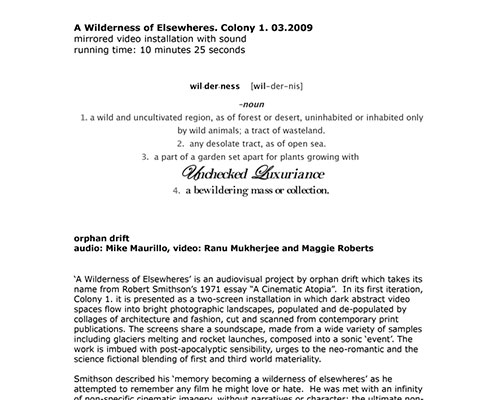
A WILDERNESS OF ELSEWHERES. COLONY 1.03.2009 mirrored video installation with sound running time: 10 minutes 25 seconds
wil•der•ness . [wil-der-nis]
–noun 1. a wild and uncultivated region, as of forest or desert, uninhabited or inhabited only by wild animals; a tract of wasteland. 2. any desolate tract, as of open sea. 3. a part of a garden set back apart for plants growing with Unchecked Luxuriance 4. a bewildering mass or collection.
0rphan Drift audio: Mike Maurillo, video: Ranu Mukherjee and Maggie Roberts
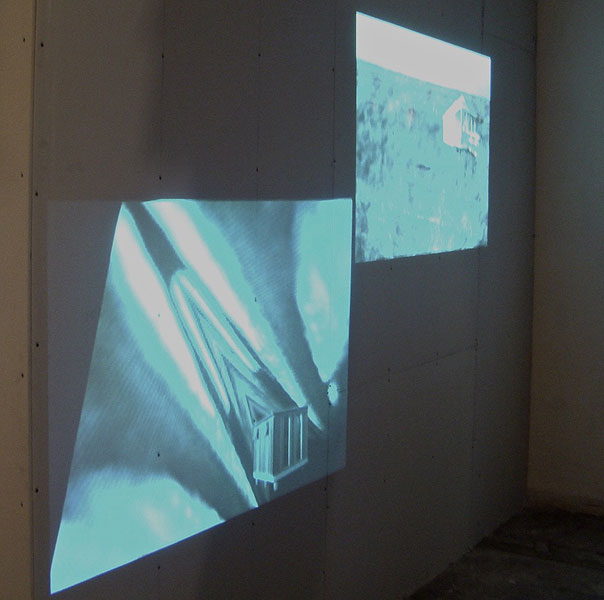
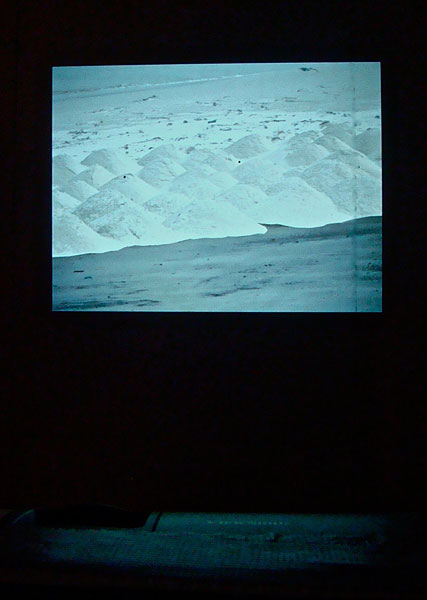
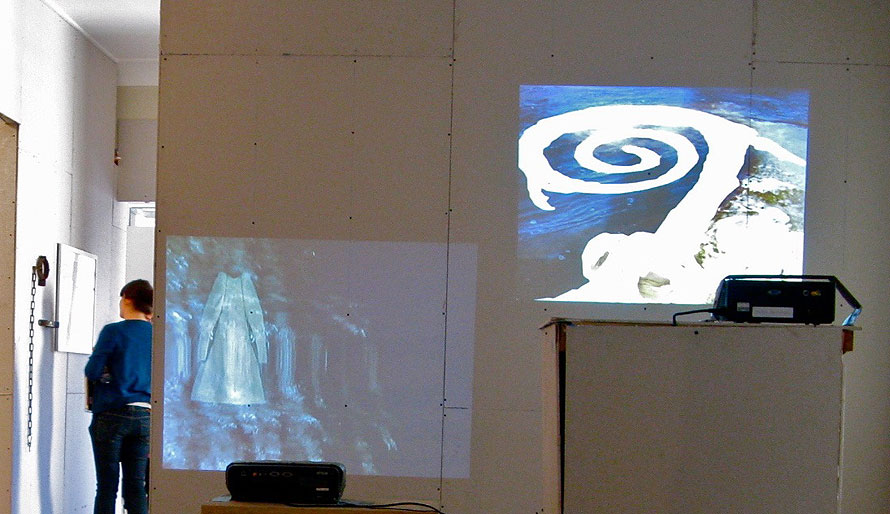
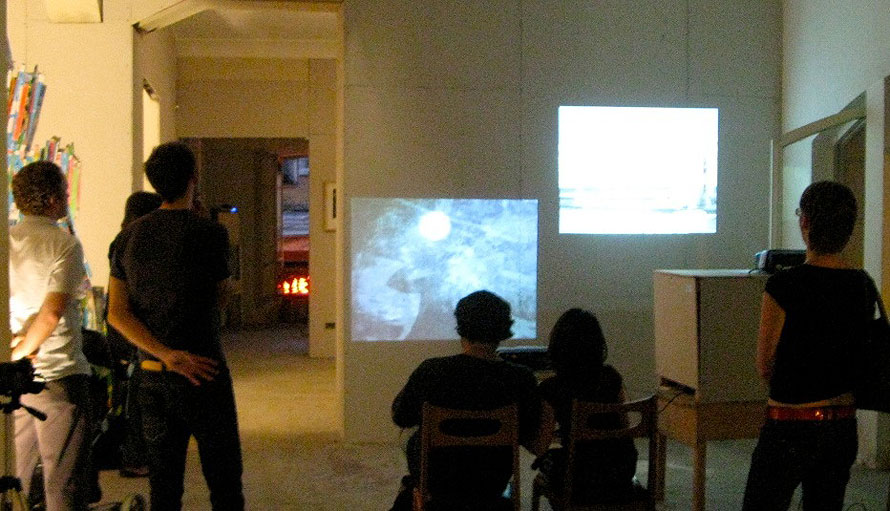
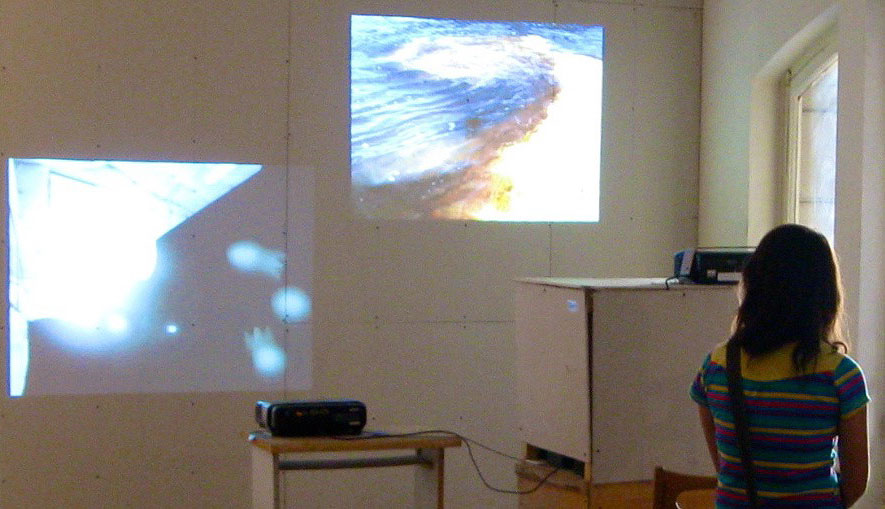
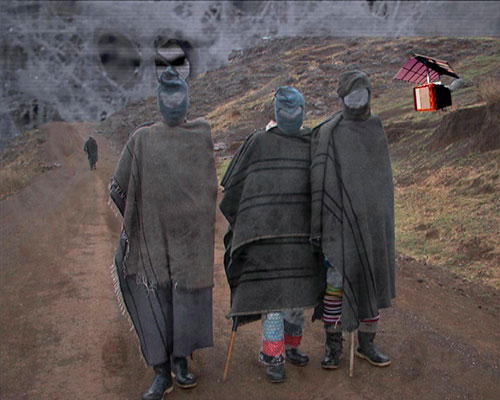
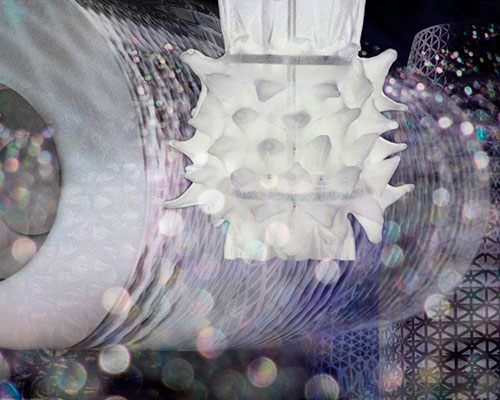
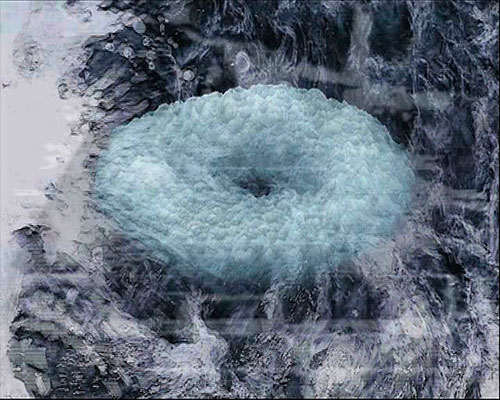
‘A Wilderness of Elsewheres’ is an audiovisual project by 0rphan Drift which takes its name from Robert Smithson’s 1971 essay “A Cinematic Atopia”. In its first iteration, Colony 1. it is presented as a two-screen installation in which dark abstract video spaces flow into bright photographic landscapes, populated and de-populated by collages of architecture and fashion, cut and scanned from contemporary print publications. The screens share a soundscape, made from a wide variety of samples including glaciers melting and rocket launches, composed into a sonic ‘event’. The work is imbued with post-apocalyptic sensibility, urges to the neo-romantic and the science fictional blending of first and third world materiality.
Smithson described his ‘memory becoming a wilderness of elsewheres’ as he attempted to remember any film he might love or hate. He was met with an infinity of non-specific cinematic imagery, without narratives or character: the ultimate non-site. In relating the contemporary screen, with its multiplicity of function as window, mirror, portal and page, to the notion of the black mirror as a predictive device, we felt this physiological wilderness extending to include real world places and global consciousness.
Colony 1, made to resemble the volcanic process which allows obsidian to form, was composed in five 2 minute sections; heat, erupt, flow, freeze and still. Drawing a parallel between the screen and the black mirror, the video artists, one in San Francisco and one in Capetown, each produced a single screen using the same source material so that they would reflect each other without being able to see each other. Also inspired by the principle of mirroring, the audio artist found organic and synthetic sounds which reflected each other to create his composition.
Obsidian, as a material made into the shape of various cultural value systems, became, for us, an embodiment of the peripheral. Formed at the edges of lava flow, its various human uses had to do with physical and metaphysical boundaries. The pre-columbian obsidian mirror was a tool for attempting to understand what is just beyond the limits of current knowledge and consciousness. The contemporary surgical instrument is a tool for making precise cuts through the edges of our bodies. The once peripheral arctic weaves its way into our every day, making our structures seem fleeting, our shelters temporary. Clothing and architecture are the edges of us. As a form of evidence and presence, they may be the objects by which the predictive mechanism of the black mirror is possible.
‘A Wildernes of Elsewheres’ describes miscegenation between human production and geologic time, primitive and contemporary technology. There is an awkward temporality in the combination of still and moving, animation and video, unapologetic collage and ‘organic’ texture. The tundra, iceflows, burns, flotsam and jetsam have an elegiac sublime tone- proliferating landscapes of aftermath- still and unyielding. The audio carries with it the persistent sense of an event. Architecture and clothing become sculptural. Collage becomes a way of thinking about edges, cutting cloth to fit a body or making a building to carve out space. It points to what happens at the edges of things, and to the history of pictorial landscape as an invention by framing. At once immersive and deconstructive, the work is collision, co-habitation, evolutionary fever-dream.
on SCIENCE FICTION and THE LIMINAL
“Liminality is a positional as well as temporal phenomenon. It is symbolic of the liminal state itself and of its permanent accessibility. A matrixial border space. A catalyst for social and individual transformation. It can overlook the usual requirements of biology, economics, socius, even of metaphysical possibility, in order to posit radically altered limits.” (Pelton “The Trickster In West Africa”, 1980).
A Wilderness of Elsewheres suggests science fictional journeys, encoding an alien timeframe- whether future or past. Tundra, ocean and ice could be the start of a cycle- the start of the technological drive to change the landscape. Yet these are the contemporary proliferating symbols of aftermath. Wildernesses fashion and architecture collages, often using futuristic, survivalist, nomadic or space travel elements, blinking in and out of existence in the inhuman raw beautiful scapes of Southern Africa, are positing haunted futures. They exist as interventions, moments on a surface. They transmit indistinct ‘meaning’ and layers of possible interpretation. The folds, surfaces and perception warps seduce with strangeness.
The animation is the metaphysical dimension- the unknown- the hidden, unidentifiable substance and trickery- communication with the unseen. Manifesting connections, threads, virtual bands of flexing matter- the animated imagery is thrust up into the flow, weaving fictive and ‘real’ dimensions.
Intimations of the Atlantis myth- operating as a feedback loop or software of the unconscious – a race that brings about it’s own destruction time-travels into the future to make it all happen again. Any culture that intensifies faces the apocalypse.
For us, to dream the future, to channel the predictive obsidian mirror, science fiction and technology become tools, such as magic once was, for transformation.
We are cutting through time, using the obsidian mirror to see past apocalyptic hauntings, to colonize experimental realities, weaving space, time and matter into fluid temporary configurations that are essentially science-fictional.
Science fiction is produced out of cultural necessity- a liminal presence that inhabits prediction and flux, resisting definition and containment. It is a trickster figure, encapsulating playful perversion, social liminality and unpredictability in order to navigate transformation.
This is the liminal: always slippery and ambiguous, dissolving boundaries and opening horizons. It is the living connection between the wild and the social, between the potentially and the actually human, an imaginer of life.
Poster
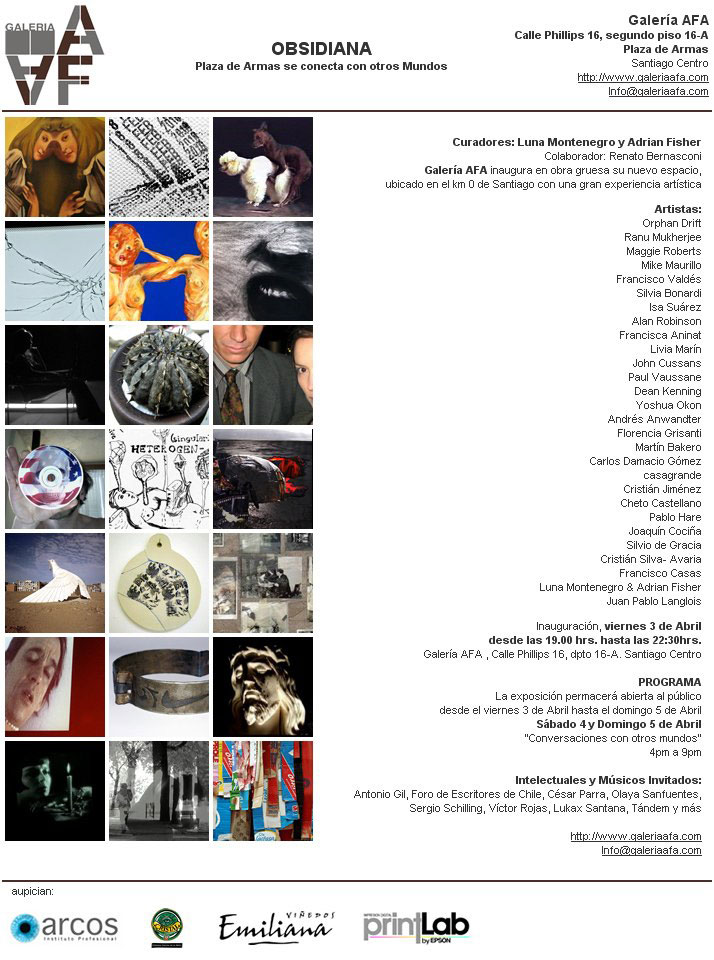
Obsidiana
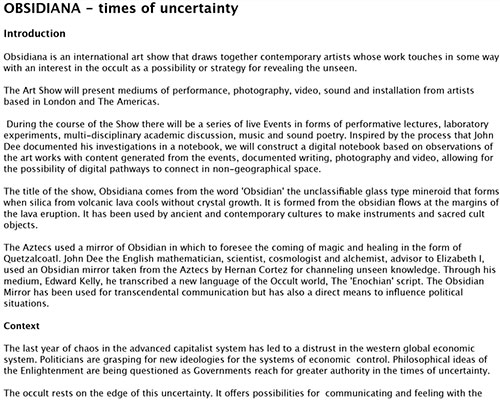
Press Release
Watch Videos
Reworked Collages
Video Stills
Share
Total
0
Shares
Liquid Lattice :: 2007
From: Maggie … Date: March 3, 2006 8:11:15 AM GMT+02:00 To: Ranu Mukherjee Subject: panic slightly
heyu, 1hr elec power in the last 24. hope battery lasts long enough 2 send this. was writing by hand then typing in by torchlite. no time yet to allocate place for the texts. hope we have power 1hr this eve then i can recharge battry wen i bak from work. and finish. i’d dig if you hold on sending final to jon til i slot these in. if you have hours to spare, you can do it but assuming you wont!!!! my fri eve your fri morn hey? thats wen i finish. xxm
The Rubbish Dump god. The R310 runs along the most beautiful of desolate coastlines. It’s suddenly desolate. You notice that slowly. An inexplicable 30km of prime land, deserted except for the passing traffic and the huge numbers of gulls wheeling over the mountainous civic dump hidden in the dunes. Invisible behind all this is the endless sprawl of Khayelitsha. The smell of squatter camp fires mingles with the salt spray. Trash blows with the sands encroaching onto the coast road. The city’s peripheries are these spaces on the townships edges. Haunting no mans lands where most of the muti killings take place. Mostly they are toxic wastelands where even the poorest wouldn’t set up home. This one on the wild shoreline is unique in it’s eerie beauty. It is ruled over by the Great Heap of Rubbish, entity from the underworld. He appears, huge and glowering, surface covered in growths of drift flotsam deposited on torn branches by raging floodwaters. He will tear you apart. At night on this road, you don’t stop or get out of your car for any reason.
A refrain: the devouring and reconstituting of you.
incidental detail: the ancestors sent a robot shark and many artificial fishes to carry them away.
you cannot know what is being experienced in those aching, blackened teeth.
The Abomination. A strange sight on the deserted beach. First you see a dolphin with a woman beside it in the shallows. The woman has a silver face and rolling eyes. Eyes so exactly the colour of the ocean, it’s as if you are seeing the water through two holes in her head. Something is snapping against her silvery skin. She sways to and fro, gesticulating with webbed fingers. You locate that slapping sound- two long slits opening and shutting loudly on her chest. She has no legs, she is the smooth dolphin aswell. Thin seaweed falls from her head- tentacles of brown, silver, green, black and grey. She is tapping her tail in the surf and staring. Her throat constricts and swells to produce clicks and hums. Her mouth opens slightly, revealing little pointed teeth in pronounced pink gums. She makes a layered undulating whisper sound, like the sea in the distance. Strange and intelligent. To you, a slimy abomination.
The Dead. The Dead took off their masks and hoods and other hybrid contraptions and their mingled bodies fitted together like machinery. A kind of horizontal evolution operates among the Dead- members of the system can turn into one another. Their mass, floating in a luminous green algae, gives off a static charge. They all have patches of skin graft, electric blue veins tracing through translucent jelly. They have grown ribs with raised markings and terrible indigo scars. Their flesh is soft and porous with ribbons of muted colour in maps all over the surface- a carapace of protection against acids and heat. The Dead program an AI and the AI programs the Dead. That was the beginning of the dreaming. You need a high tolerance for chaos. Witchdoctor Radio relays a storm of deconstructed sonic jetsam: undone narratives in a sensory and cognitive environment of time so looped and braided, the paradoxes lie six deep. Unribboning.
the devouring and reconstituting of you.
The power cuts. Mostly you’re in the dark, a small circle of light, fuzzy round the edges, goes ahead at all times, coaxing objects into your path.
The current recedes into the other side. Again. Stealthy withdrawal in mid pulse. And sinister in it’s quiet. Enough power running through the channels to kill, maim, blind, fry, boil, shred, explode… unexpected that it moves with such seeming softness. And reappears after so long a crippling absence, like a familiar ghost in its camouflage of containment. Still unnervingly silent. It surges. It will blow your mind and your machines, were it to escape its regulated pathways and return to the lightening.
The Trickster. Abstraction, accumulation, obscurity, omission and containment are some of the tools of secrecy in the Ancestors. Process is always being re imagined. He is the figure who deals with discontinuity and change. He springs out of nothing, crosses time and disappears. Mimetic with the outside. Be modified by every other world. For this, you need a fascination with orifices and dissolution. he is an aberrant fluid, returning matter to the potency of formlessness. Out into the wild epigenetic spiral, no interest in linear evolution. Catalyser. finding a seam between zones. giving shape to the dark.


 That sound and affect are fatally entangled should be obvious, for they share a primordial relation to a zone of indetermination between unconscious bodily impingements and their selective, conscious actualization. This is further suggested by the way sound’s im-mediacy and hearing’s continuous intake figure audition as a amenability to influenza of various forms that nudge virtual potentials towards predetermined outcomes. For contemporary cybercapitalist power, sound’s affective/infective nature plays a key role in ratifying its need to preserve homeostasis through a negative feedback that holds matter and information as equal realities. According to Anahid Kassabian, in a world of ubiquitous, networked technologies, music and sound are crucial vectors across which distributed-informatic subjectivities are constituted, a position advanced by the third wave of cybernetics wherein machinic, mediatic, and prosthetic ecologies have become indissociable from biological processes. Indeed, within this human/non-human commingling control operates virtually, nested within affective states that “unfold the past into the present” and inflect “the way the present acts on the past to unravel a new future.”